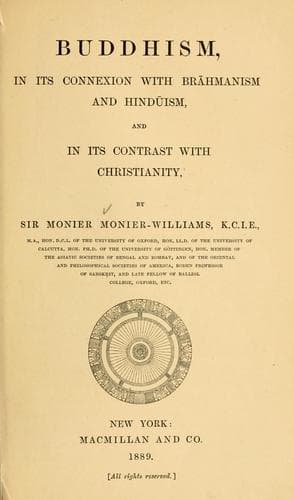
Buddhism, in Its Connexion with Brahmanism and Hinduism, and in Its Contrast with ChristianityMonier-Williams, Monier, Sir
Religion
Buddhism, in Its Connexion with Brahmanism and Hinduism, and in Its Contrast with Christianity
Monier-Williams, Monier, Sir
Buddhism; Buddhism -- Relations -- Christianity; Christianity and other religions -- Buddhism; India -- Religion
Thus we read that ‘on the day of full moon Ānanda purified himself, and
went up to the upper story of his house to keep the sacred day’
(Mahāsudassana-sutra, 1-10). This was in conformity with the ancient
Brāhmanical rule that every new-moon day (Darṡa) and every full-moon day
(Paurṇamāsa) should be set apart for special religious observances[156].
In later times the intermediate quarter-moon days were also held sacred,
and so the number of Uposatha days (see p. 84) was increased to four in
every month, or once a week. Very strict Buddhists in Tibet eat nothing
on these days between sunrise and sunset except farinaceous food with
tea (p. 346).
The laity are invited to join in keeping the Uposatha days, but take no
real part in the detail of the services. The same rule applies to all
religious ceremonies. Laymen may be present at any rite, but without
co-operating in carrying out the ritual. Still, laymen have their own
part to perform. They look on—listen, tell their rosaries, and repeat
short prayers—such as the ‘three-refuge’ and ‘jewel-lotus’ formula (pp.
78, 370)—and make declarations to avoid the five great sins (p. 126). Or
they walk up to the image-altar and place offerings on it, or bow before
it and receive the Lāma’s benediction. Theoretically, the laity only
exist to honour and support the monkhood, and to be blessed by them in
return. At all events a layman’s religion is usually restricted to a
very limited range of duty.
One common way of showing piety is by walking round temples,
monasteries, Stūpas, and sacred walls (see pp. 380, 505), from east to
west, keeping the right shoulder towards them, and even occasionally
measuring the ground with the extended body.
Public-domain text, read in full here on John Shaqi.
Reviews
Reviews
No reviews yet
Be the first to share your thoughts on this work.
Elsewhere in the archive
Join the Discussion
Join the discussion
Sign in to leave a comment or review.
Sign InorCreate an account