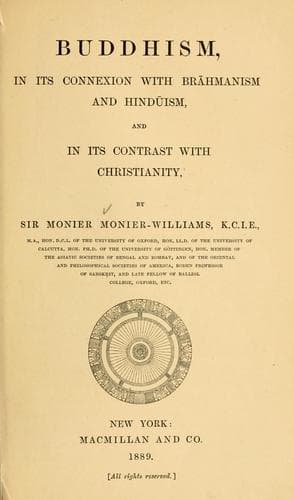
Buddhism, in Its Connexion with Brahmanism and Hinduism, and in Its Contrast with ChristianityMonier-Williams, Monier, Sir
Religion
Buddhism, in Its Connexion with Brahmanism and Hinduism, and in Its Contrast with Christianity
Monier-Williams, Monier, Sir
Buddhism; Buddhism -- Relations -- Christianity; Christianity and other religions -- Buddhism; India -- Religion
In Tibet there is a ‘water-festival’ in the seventh or eighth month
(about our August and September). At this festival the Lāmas go in
procession to rivers and lakes, and consecrate the waters by benediction
or by throwing in offerings. Huts and tents are erected on the banks,
and people bathe and drink to wash away their sins. It concludes with
dancing, buffoonery, and masquerading.
The festival of Gautama Buddha’s conception, or of the Buddha’s _last_
birth—for it must be borne in mind that, before Buddhahood, he went
through innumerable previous births—is a most important anniversary in
all Buddhist countries, but the right date has been the occasion of much
controversy. The event is generally celebrated at the end of April, or
beginning of May, or on a day corresponding to the 15th day of the Hindū
month Vaiṡākha, which is also sometimes given as the date of the
Buddha’s attainment of Buddhahood, and of his death. Everywhere
throughout the modern Buddhist world the Buddha’s birthday is kept by
the worship of his images, followed by processions.
As to the day of his death, Sarat Chandra Dās was at Lhāssa on June 1,
1882, and wrote thus:—‘To-day being the holiest day of the year—the
anniversary of Buddha’s Nirvāṇa—the burning of incense in every shrine,
chapel, monastery, and house, darkened the atmosphere with smoke. Men
hastened to the great temple to do homage to the Buddha and to obtain
his blessing.’
The ‘festival of lamps’ is an important anniversary with all Buddhists.
The Hindūs have their Dīvālī or feast of illuminations (see ‘Brāhmanism
and Hindūism,’ p. 432) when the cold season begins. The early Buddhists
marked the end of the rainy season (Vassa = Varsha), which terminated
their period of retirement, by a day of rejoicing (see p. 84). In
process of time they connected the celebration of Gautama’s descent from
heaven (p. 417) with the termination of Vassa.
In Tibet the orthodox followers of the Dalai Lāma have a festival of
their own, with illuminations, on the 25th day of the 10th month
(Nov.—Dec.), to celebrate the ascension of Tsong Khapa to heaven (p.
280). Sarat Chandra Dās was at Tashi Lunpo on this day in 1881, when
‘hundreds of lamp-burners were tastefully placed in rows on the roof of
every building.’ The illuminations of the temples, tombs, and grand
monastery ‘presented a magnificent appearance.’
With regard to the season called Vassa, it should be noted here that
since there is no rainy period of the year in Tibet which corresponds to
the Indian ‘Rains,’ certain seasons of abstinence from food are observed
either before, or at the same time with the great Festivals. These
periods of fasting are distributed equally throughout the year—one in
February, one in May, one in July, one in November or December.
Public-domain text, read in full here on John Shaqi.
Reviews
Reviews
No reviews yet
Be the first to share your thoughts on this work.
Elsewhere in the archive
Join the Discussion
Join the discussion
Sign in to leave a comment or review.
Sign InorCreate an account