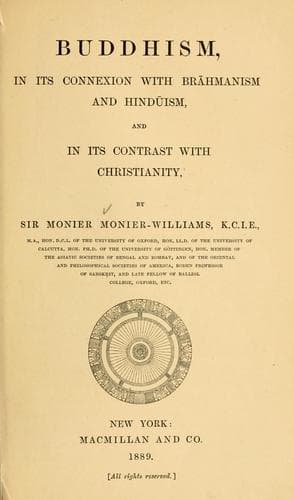
Buddhism, in Its Connexion with Brahmanism and Hinduism, and in Its Contrast with ChristianityMonier-Williams, Monier, Sir
Religion
Buddhism, in Its Connexion with Brahmanism and Hinduism, and in Its Contrast with Christianity
Monier-Williams, Monier, Sir
Buddhism; Buddhism -- Relations -- Christianity; Christianity and other religions -- Buddhism; India -- Religion
The festivals and holy days thus briefly described, are by no means the
only festivals of Buddhism. There are numerous other special and local
ones. For example, in Ceylon, the Sinhalese celebrate the coming of the
Buddha to their island and his victory over the Rākshasas and evil
demons by a festival in March or April, when the greater number of
pilgrims flock to his supposed foot-print on Adam’s Peak, or to the
sacred Bodhi-tree at Anurādha-pura (see p. 519). Other Southern
countries have festivals connected with the worship of special
foot-prints and relics of their own.
Then the Lāmas in Lhāssa keep the day of the worship of the Dorje (see
p. 322) on the 27th day of the first month, while those in Sikkim
celebrate as a festival the day on which the Lepchas make offerings to
the spirit of the mountain Kinchinjunga.
Then, again, at the beginning of the third month an exhibition of sacred
vessels and pictures takes place at Lhāssa, accompanied by processions
in masks, the Lāmas appearing as good genii, and the laity as tigers,
leopards, elephants, &c.
In other places, too, there are special festivals. For example, a
singular festival, called ‘Chase of the spirit-kings,’ is kept by
Northern Buddhists on the 30th of the second month, when there is a vast
amount of religious dancing (with tediously slow movements),
masquerading, mummery, and buffoonery, not unlike the devil-dancing
which goes on in Ceylon, and closely connected with the universal belief
in demons and evil spirits.
The most hideous masks are used on these occasions. In 1884 I had an
opportunity of inspecting in a Buddhist monastery near Dārjīling a most
singular assortment of religious masks, which for distortion of feature
and horrible unsightliness, could scarcely be matched anywhere; for
indeed mask-making is an art which Buddhism has brought to the greatest
perfection. I also witnessed a religious dance performed by a party of
masqueraders which struck me as a remarkable example of the utter
debasement of Buddhism in Northern countries.
Mrs. Bridges describes a similar religious dance in Ladāk thus:—
‘A group of grinning masks—lions’ heads and harlequins’ bodies—came
down the steps, and whirling slowly round, retreated again into the
gloom and came out dragon-headed. Then a band of skeletons, the skulls
(masks) admirably painted, gnashing their hideous jaws and shaking
their lanky limbs, rushed out into the sunshine and executed a real
“Dance of Death” before us.’ (‘Travels,’ p. 101.)
Yet all true Buddhists are prohibited from dancing and masquerading (p.
126 of this volume); just as Manu (II. 178, IV. 15, 212) prohibited
Brāhmans from engaging in similar frivolities.
Then the religious dramas performed on some of the Buddhist festive days
are not the least interesting examples of the present prevalent
superstitions.
Public-domain text, read in full here on John Shaqi.
Reviews
Reviews
No reviews yet
Be the first to share your thoughts on this work.
Elsewhere in the archive
Join the Discussion
Join the discussion
Sign in to leave a comment or review.
Sign InorCreate an account