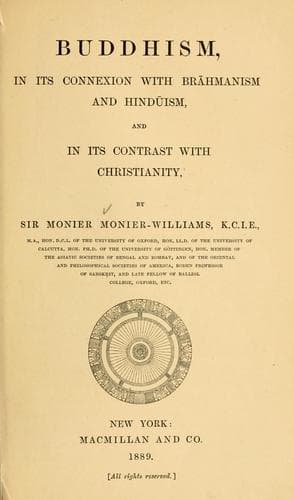
Buddhism, in Its Connexion with Brahmanism and Hinduism, and in Its Contrast with ChristianityMonier-Williams, Monier, Sir
Religion
Buddhism, in Its Connexion with Brahmanism and Hinduism, and in Its Contrast with Christianity
Monier-Williams, Monier, Sir
Buddhism; Buddhism -- Relations -- Christianity; Christianity and other religions -- Buddhism; India -- Religion
According to M. Huc, a common funeral ceremony among the Mongols
consists in carrying the corpse to the summit of a mountain, or to the
bottom of a ravine. The body is walled up in a sort of kiln of a
pyramidal form, with a small door at the bottom, and an opening at the
top to maintain a current of air, and allow the smoke to escape. During
the combustion the Lāmas recite prayers. When the corpse is consumed,
the kiln is demolished. Then the bones are collected and carried to the
Grand Lāma, who reduces them to a powder, and, after adding an equal
quantity of wheaten flour, kneads the whole carefully, and, with his own
hands, fashions a number of cakes of various sizes. These are afterwards
placed in a pyramidal Stūpa, which has been built beforehand in some
auspicious place.
The soil of the famous monastery of the Five Towers in the province of
Shan Si, is said to be so holy that those interred there are sure to
effect a good transmigration. In the deserts of Tartary, Mongols are
frequently seen carrying on their shoulders the bones of their kindred,
and journeying to the Five Towers—there to purchase, almost at its
weight in gold, a little surface of ground whereon to erect a small
Stūpa. Some of them undertake a toilsome journey of a whole year’s
duration, to reach this holy spot (see p. 435).
Burial in rivers, which is highly prized by the Hindūs, is not in favour
among Buddhists. Only very poor people allow their dead to be thrown
into rivers, though this is the only kind of Buddhist burial mentioned
by Alberūnī (Sachau, ii. 169). Buddhism, from the first, repudiated the
Hindū funeral ceremonies called Ṡrāddhas, which are still a great
incubus on the people. The poorest man in India, if he be of high caste,
cannot perform a Ṡrāddha for a relation for a less sum than forty
rupees, given in fees to the priests. Buddhism did good service in
delivering the people from this burden, but in Northern countries it
established something similar in the Bardo ceremony (p. 334).
_Formularies of Prayer._
With regard to prayer-formularies, there is in modern times a good deal
of difference between Southern and Northern Buddhist countries. We have
seen that the three-refuge formulary was the sole prayer of early
Buddhists. Certain orthodox men whom I met in Ceylon, maintained to me
that this is the only legitimate form of prayer that ought to be used
even in the present day. It is certainly a form which is accepted and
employed by all Buddhists of whatever nationality.
Tsong Khapa, it is said, established at Lhāssa an annual
prayer-congregation called Monlam Ćhenpo (see p. 386). But the most
common prayer used in Tibet is a mere formulary, the constant repetition
of which is one of the most amazing instances of the tyranny of
superstition to be found in any part of the world.
It consists of the six-syllabled sentence, Om maṇi padme Hūm, ‘Om! the
Jewel in the Lotus! Hūm!’
Public-domain text, read in full here on John Shaqi.
Reviews
Reviews
No reviews yet
Be the first to share your thoughts on this work.
Elsewhere in the archive
Join the Discussion
Join the discussion
Sign in to leave a comment or review.
Sign InorCreate an account