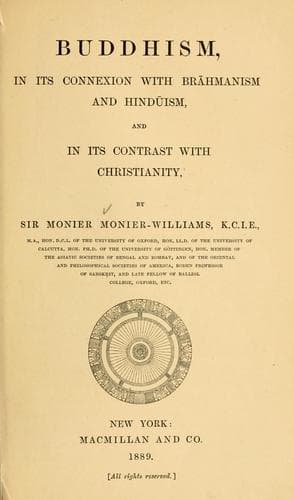
Buddhism, in Its Connexion with Brahmanism and Hinduism, and in Its Contrast with ChristianityMonier-Williams, Monier, Sir
Religion
Buddhism, in Its Connexion with Brahmanism and Hinduism, and in Its Contrast with Christianity
Monier-Williams, Monier, Sir
Buddhism; Buddhism -- Relations -- Christianity; Christianity and other religions -- Buddhism; India -- Religion
This prayer, or rather mystical sentence, is supposed to have been
composed by Padma-pāṇi (Avalokiteṡvara), and to have reference to his
own manifestation as the Patron-Saint of Tibet[173]. It is sometimes
called the Maṇi or ‘Jewel’ prayer, and, if brevity is a valuable
quality, its excellence is undeniable, since it consists of merely two
Sanskṛit words, between two mystical, untranslatable auspicious
ejaculations, Om and Hūm[174].
Doubtless the prayer really owes its origin to the close connexion which
sprang up between Northern Buddhism and Ṡaivism. The worshippers of Ṡiva
have always used (compare p. 240) similar mystical sentences and
syllables called Dhāraṇīs, to which a kind of miraculous efficacy is
attributed. In all probability an occult meaning underlies the
‘Jewel-lotus’ formula, and my own belief is that the majority of those
who repeat it are ignorantly doing homage to the self-generative power
supposed to inhere in the universe—a power pointed at by the popular
Sāṅkhya theory of the union of Prakṛiti and Purusha, and by the
universal worship of the Liṅga and Yoni throughout India[175]. No
thoughtful person can have travelled much in India without being
impressed with this.
At all events, whatever be its origin and meaning, no other prayer used
by human beings in any quarter of the globe is repeated so often. Every
Tibetan believes it to be a panacea for all evil, a compendium of all
knowledge, a treasury of all wisdom, a summary of all religion. But if
you ask Northern Buddhists to give you the reason for this belief, very
few are able to give an intelligible reply. According to the most
learned doctors of philosophy who are to be found in Tibetan
monasteries, it is certainly addressed to their patron deity
Avalokiteṡvara, and the real secret of its efficacy lies in the fact,
that each one of its six syllables has a potent influence on some one of
the six _Gatis_ or courses of being—that is to say, on some one of the
six kinds of transmigration or transformation through which every living
individual has to pass (see p. 121)[176].
The oftener, therefore, this mystical formula is repeated the shorter
will be an individual’s course (gati) through some of these six forms of
existence, every one of which involves misery or evil. Or it may be that
by repeating it he will be able to escape some of the six existences
altogether.
Strange indeed as it may appear to us, it is impossible to shake the
faith of a Lāmistic Buddhist in the absolutely infallible efficacy of
his six favourite mystic syllables. He repeats them, not at all as if he
were praying in a Christian sense, but as if he were a farmer intent on
planting the very best seed in the most productive soil, and watering it
incessantly according to the most scientific principles of irrigation. A
bountiful harvest is absolutely certain to reward his efforts.
Public-domain text, read in full here on John Shaqi.
Reviews
Reviews
No reviews yet
Be the first to share your thoughts on this work.
Elsewhere in the archive
Join the Discussion
Join the discussion
Sign in to leave a comment or review.
Sign InorCreate an account