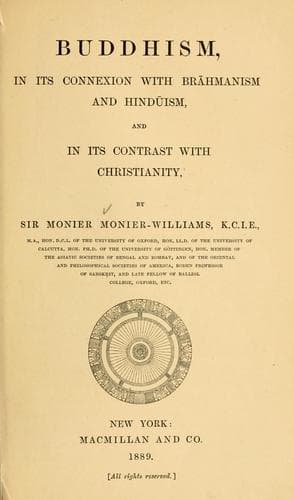
Buddhism, in Its Connexion with Brahmanism and Hinduism, and in Its Contrast with ChristianityMonier-Williams, Monier, Sir
Religion
Buddhism, in Its Connexion with Brahmanism and Hinduism, and in Its Contrast with Christianity
Monier-Williams, Monier, Sir
Buddhism; Buddhism -- Relations -- Christianity; Christianity and other religions -- Buddhism; India -- Religion
An intricate arrangement of huge wheels and other wheels within wheels,
like the works of a clock, is connected with rows of cylinders and made
to revolve rapidly by means of heavy weights. An infinite number of
prayers are repeated in this manner by a single monk, who takes a minute
or two to wind up the complicated spiritual machinery, and then hastens
to help his brothers in industrial occupations—the whole fraternity
feeling that the ingenious contrivance of praying by clock-work enables
them to promote the common weal by making the most of both worlds. The
story goes that, in times of special need and emergency, additional
weights are attached to the machinery, and, of course, increased cogency
given to the rotatory prayers. It is to be hoped that when European
inventions find their way across the Himālayas, steam-power may not be
pressed into the service of these gross superstitions.
The use of prayer-wheels of various kinds is also common in Japan, as
described in Sir Edward Reed’s work.
But praying by machinery is not all. Beneficial results are believed to
accrue through the carving of the all-powerful six syllables on every
conceivable object.
The traveller, as he walks along, sees the mystic words impressed on the
stones at his feet, on rocks, doors, monuments, and trees. Indeed, rich
and zealous Buddhists maintain at their own expense, companies of Lāmas
for the sole object of propagating the Maṇi-padme formula. These strange
missionaries may occasionally be encountered, chisel and hammer in hand,
traversing field, hill, dale, and desert, their only mission being to
engrave the sacred six syllables on every rock in their path (Huc, ii.
194).
Absolutely incalculable is the grand total of Maṇi-padmes thus placed to
the credit of the world of living beings during the short space of
twenty-four hours. Yet, at the end of the New Year’s festival in Tibet,
the chief Lāma will sometimes pretend to proclaim the exact sum of
mystic syllables supposed to have been repeated during its continuance,
amounting perhaps to billions upon billions, for the consolation of all
those faithful Buddhists who, oppressed by the evils of life, are
seeking for some antidote.
But the ‘jewel-lotus’ is not the only antidote. There are other short
prayer-formularies, such as Om Vajra-pāṇi-Hūm (addressed to the
Bodhi-sattva Vajra-pāṇi, p. 201), and other still more mystical
ejaculations (such as Om ah Hūm); and magical sentences, called Dhāranī,
and profoundly significant monosyllables, such as Ram, Phaṭ, Hṛim, Hṛīm,
Ṛim, Ṛīm, Hṛīs.
And here in connexion with the ubiquity of prayer-formularies, we must
not omit to notice the _Praying-walls_, that is, the long stone walls or
banks called (from the ‘jewel-lotus’ prayer inscribed upon them)
_Maṇi_[178], or in the provincial dialect Man Dang (variously Man-dong,
Mendong).
Public-domain text, read in full here on John Shaqi.
Reviews
Reviews
No reviews yet
Be the first to share your thoughts on this work.
Elsewhere in the archive
Join the Discussion
Join the discussion
Sign in to leave a comment or review.
Sign InorCreate an account