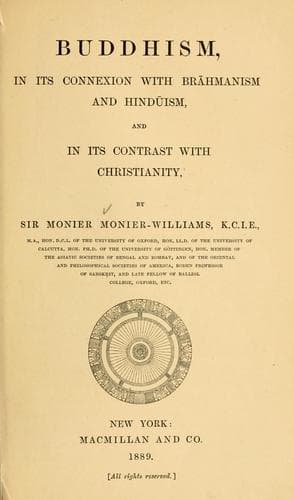
Buddhism, in Its Connexion with Brahmanism and Hinduism, and in Its Contrast with ChristianityMonier-Williams, Monier, Sir
Religion
Buddhism, in Its Connexion with Brahmanism and Hinduism, and in Its Contrast with Christianity
Monier-Williams, Monier, Sir
Buddhism; Buddhism -- Relations -- Christianity; Christianity and other religions -- Buddhism; India -- Religion
Before, therefore, concluding this Lecture we must acknowledge, in
fairness to the inhabitants of Tibet, that much of the spirit of
religion may be mingled with their superstitions. The words of their
prayers are not merely repeated by machinery, written on paper, and
inscribed on rocks and stones. The voices of men and women, if not their
thoughts, often go heartily with uttered prayers. The note of prayer is
raised at all times and seasons—in the morning, mid-day, and evening, in
private and in public, at home or abroad, in the midst of labour and
idleness, in lying down and rising up, in moving about and keeping
still, on the march and on the battle-field, on mournful occasions, and
in the midst of joy and laughter. Nor is any one ashamed of praying
aloud or praying together in the open streets and squares of crowded
towns.
‘There exists,’ says the French Missionary (ii. 194), ‘a very touching
custom at Lhāssa. In the evening, just as the day is verging on its
decline, all the Tibetans stop business and meet together, men, women,
and children, according to their sex and age, in the principal parts of
the town and in the public squares. As soon as groups are formed, every
one kneels down, and they begin slowly and in undertones to chant
prayers.
‘The religious concerts produced by these numerous assemblages create
throughout the town a solemn harmony, which operates forcibly on the
soul. The first time we witnessed this spectacle, we could not help
drawing a painful comparison between this pagan town, where all prayed
together, and the cities of Europe, where people would blush to make the
sign of the cross in public.’
LECTURE XIV.
_Sacred Places._
It was only to be expected, that Buddhism, closely connected as it was
with Brāhmanism and Hindūism, and yet in some respects opposed to those
systems, should have certain sacred places and hallowed regions, some of
which were identical with those of Brāhmanism and Hindūism, and some
peculiarly its own.
In the Mahā-parinibbāna-sutta (V. 16-22, Rhys Davids), we have the
following declaration:—
‘There are four places which the believing man should visit as a
pilgrim with feelings of reverence and awe. The place at which he can
say, “Here the Tathāgata (one of the names of Buddha, see p. 23) was
born.” The place at which he can say, “Here the Tathāgata attained to
perfect insight and enlightenment.” The place at which he can say,
“Here the Law was first preached by the Tathāgata.” The place at which
he can say, “Here the Tathāgata passed finally away in that utter
passing away which leaves nothing whatever behind” (see p. 142, note,
and p. 477).
‘And they who die, while with believing heart they journey on such
pilgrimages, shall be reborn, in the happy realms of heaven.’
Public-domain text, read in full here on John Shaqi.
Reviews
Reviews
No reviews yet
Be the first to share your thoughts on this work.
Elsewhere in the archive
Join the Discussion
Join the discussion
Sign in to leave a comment or review.
Sign InorCreate an account