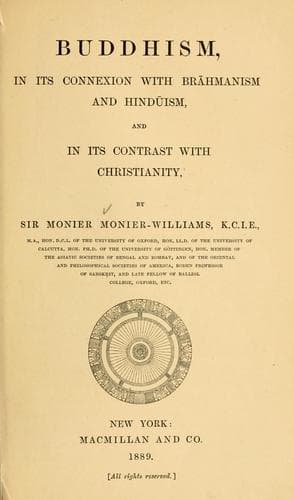
Buddhism, in Its Connexion with Brahmanism and Hinduism, and in Its Contrast with ChristianityMonier-Williams, Monier, Sir
Religion
Buddhism, in Its Connexion with Brahmanism and Hinduism, and in Its Contrast with Christianity
Monier-Williams, Monier, Sir
Buddhism; Buddhism -- Relations -- Christianity; Christianity and other religions -- Buddhism; India -- Religion
When Ānanda was going from Magadha to Vaiṡālī, wishing his
Pari-nirvāṇa to take place there, king Ajāta-ṡatru heard of his
intention, and set out with his retinue to follow him.
The Liććhavis, too, when they heard that Ānanda was coming to their
city, went out to meet him. In this way both parties arrived together
at the river, and Ānanda, thinking to himself that he ought to please
both, burnt his own body in the middle of the river, and thus attained
Pari-nirvāṇa in a fiery ecstasy of Samādhi. Then his body was divided
into two, so that each got one half as a sacred relic (Legge, pp.
75-77).
_Kauṡāmbī._
Kauṡāmbī (in Pāli Kosāmbī), now Kosam[210], on the river Jumnā, about
thirty miles from Allahābād, was once a place hallowed by many
Brāhmanical associations, and is mentioned in the Rāmāyaṇa. It was the
capital of the Kauṡāmba country, and is said to have been founded by
Kuṡāmba, tenth in descent from Purūravas. Without doubt it was one of
the most ancient cities of India. It was also the city of King Udayana,
whose story is alluded to by the greatest of all Sanskrit poets,
Kāli-dāsa, in his ‘Cloud-Messenger[211].’ Furthermore, Kauṡāmbī is the
city in which the scene of the Sanskṛit drama Ratnāvalī was laid[212].
The Buddha resided there in the sixth and ninth years of his Buddhahood,
and probably visited the place at other times. This was the chief cause
of its reputation in connexion with Buddhism. But it also derived its
sacred character from the fact that it contained the celebrated
sandal-wood image[213] of the Buddha, believed to have been carved
during his life-time, by a sculptor sent by Moggallāna (see last line,
p. 414) at King Udayana’s request, to the Trayastriṉṡa heaven, when the
Buddha was there preaching the Law to his mother (see p. 207).
In a village near at hand Sir A. Cunningham (i. 308) found two
sculptured pillars, and the pedestal of a statue inscribed with the ‘Ye
dharmā’ formula (see p. 104). A great monolith was also discovered
there. In Fā-hien’s time a Vihāra existed at the spot where the Buddha
had explained the Law (Legge, p. 96). Hiouen Thsang mentions that a
lofty Stūpa, 200 feet high, was erected by Aṡoka near at hand.
There was also a cavern in which the Buddha had left his shadow
impressed on the rock. He also speaks of ten monasteries all in ruins.
_Nālanda._
Public-domain text, read in full here on John Shaqi.
Reviews
Reviews
No reviews yet
Be the first to share your thoughts on this work.
Elsewhere in the archive
Join the Discussion
Join the discussion
Sign in to leave a comment or review.
Sign InorCreate an account