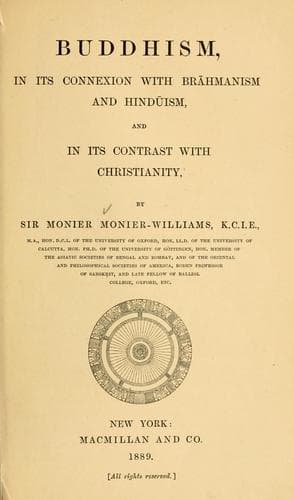
Buddhism, in Its Connexion with Brahmanism and Hinduism, and in Its Contrast with ChristianityMonier-Williams, Monier, Sir
Religion
Buddhism, in Its Connexion with Brahmanism and Hinduism, and in Its Contrast with Christianity
Monier-Williams, Monier, Sir
Buddhism; Buddhism -- Relations -- Christianity; Christianity and other religions -- Buddhism; India -- Religion
Nālanda[214] was the greatest seat of Buddhist learning in India. It has
been identified by Sir A. Cunningham with the village of Baragaon, about
seven miles north of Rāja-gṛiha, about thirty miles south-east of the
modern Patnā, and about forty miles from Buddha-Gayā. Sir Alexander
states that Baragaon possesses immense ruins and more numerous specimens
of sculpture than any other place visited by him. According to Hiouen
Thsang, the Buddha preached the Law there for three months. The vast
extent and importance of the monastery (Saṅghārāma) or monasteries at
Nālanda have been already alluded to (p. 169). Fā-hien, however, does
not mention them, which seems to indicate that they were built
subsequently to A.D. 425. Hiouen Thsang, who travelled in the seventh
century, is said to have resided there for five years as a student. Ten
thousand monks, renowned for their learning, lived and studied in six
magnificent buildings. The following is an extract from the later
Chinese traveller’s description of it (Beal, ii. 70):—
The monks of Nālanda, to the number of several thousands, are men of
the highest ability. Their conduct is pure and unblamable, although
the rules of the monastery are severe. The day is not sufficient for
asking and answering profound questions. From morning till night the
monks engage in discussion; the old and the young mutually helping one
another. Those who cannot discuss questions out of the Tripiṭaka are
little esteemed, and are obliged to hide themselves for shame. Hence
learned men from different cities come here in multitudes to settle
their doubts; and thence the streams of their wisdom spread far and
wide. For this reason some persons usurp the name of Nālanda students,
and in going to and fro receive honour in consequence.
If men from other quarters desire to enter and take part in the
discussions, the keeper of the gate proposes some hard questions;
those who are unable to answer have to retire. One must have studied
deeply both old and new books, before gaining admission. Those
students who come as strangers, have to show their ability by hard
discussion; those who fail compared with those who succeed are as
seven or eight to ten.
_Saṅkāṡya._
Saṅkāṡya, now called Saṅkisa, about fifty miles north-west of Kanouj,
was identified by Sir A. Cunningham in 1842. It was evidently once a
large town with many remarkable monuments, and ought to be reckoned
among the most sacred places of Buddhism. Hiouen Thsang describes it
under the name Kie-pi-tha (Kapitha).
Public-domain text, read in full here on John Shaqi.
Reviews
Reviews
No reviews yet
Be the first to share your thoughts on this work.
Elsewhere in the archive
Join the Discussion
Join the discussion
Sign in to leave a comment or review.
Sign InorCreate an account