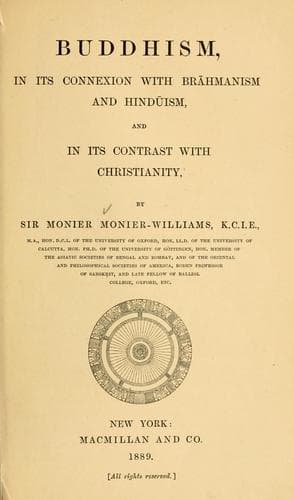
Buddhism, in Its Connexion with Brahmanism and Hinduism, and in Its Contrast with ChristianityMonier-Williams, Monier, Sir
Religion
Buddhism, in Its Connexion with Brahmanism and Hinduism, and in Its Contrast with Christianity
Monier-Williams, Monier, Sir
Buddhism; Buddhism -- Relations -- Christianity; Christianity and other religions -- Buddhism; India -- Religion
Notwithstanding Hiouen Thsang’s description of various Stūpas,
monasteries and monuments seen by him, General Sir A. Cunningham was not
able to identify any of the existing ruins in the neighbourhood of
Kanouj, ‘so completely has almost every trace of Hindū occupation been
obliterated by the Musalmāns’ (Report, i. 284).
Fā-hien mentions a Stūpa near the town, built on the spot where the
Buddha preached a discourse on ‘the bitterness and vanity of life,’
comparing it to ‘a bubble or foam on water’ (Legge, 54).
_Pāṭali-putra._
Pāṭali-putra (now Patnā) seems to have existed as a village at a very
early period. Its ancient name was Kusuma-pura. It was enlarged and
practically founded about the time of the Buddha’s death by
Ajāta-ṡatru[219], who did not, however, remove there from his own
capital city Rāja-gṛiha. One of his successors, the great King Aṡoka,
the well-known patron of Buddhism (p. 66), converted Pāṭali-putra into
the metropolis of the kingdom of Magadha, and it thenceforward became an
important centre of Buddhism. Sir A. Cunningham states that it continued
flourishing as the capital of the great Gupta kingdom during the fourth
and fifth centuries of the Christian era.
Fā-hien relates a tradition that King Aṡoka’s palace in the city was
built by genii (spirits), who brought great rocks and constructed
chambers by heaping them together. He describes a monastery belonging to
the Great Vehicle, and a temple belonging to the Little Vehicle, in the
neighbourhood of the city, and gives an account of a Buddhist procession
of four-wheeled cars and images which took place once a year. Each car
was twenty-two feet or more high, and had five stories, with niches on
four sides, in which were placed images of the Buddha and the
Bodhi-sattvas, along with images of the gods (dēvas). They were made to
look like moving pagodas (or Dāgabas). The Hindūs, as we know, have
similar car-processions to this day, when the images of Kṛishṇa are
dragged through the streets of towns and villages.
Fā-hien mentions the interesting fact that the nobles of the country had
founded hospitals in the city to which destitute, crippled, and diseased
persons might repair, and receive advice, food, and medicines suited to
their cases, gratuitously. He adds that Aṡoka, wishing to build 84,000
Stūpas[220] in place of the eight originally constructed over the
Buddha’s ashes, built the first Stūpa and a pillar near Pāṭali-putra.
Near it he says was an impression of the Buddha’s foot, over which a
temple with a door towards the north had been erected (Legge, pp. 77-80;
Beal, i. lv-lviii). The position of the Stūpa and column has been
discovered by Sir A. Cunningham (xi. 157, 158).
_Kesarīya._
Public-domain text, read in full here on John Shaqi.
Reviews
Reviews
No reviews yet
Be the first to share your thoughts on this work.
Elsewhere in the archive
Join the Discussion
Join the discussion
Sign in to leave a comment or review.
Sign InorCreate an account