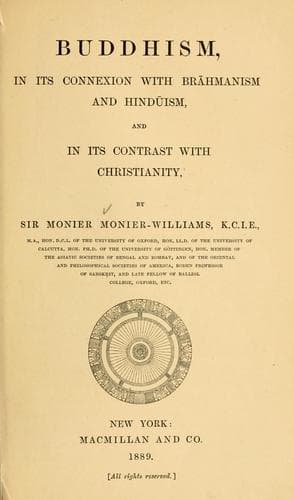
Buddhism, in Its Connexion with Brahmanism and Hinduism, and in Its Contrast with ChristianityMonier-Williams, Monier, Sir
Religion
Buddhism, in Its Connexion with Brahmanism and Hinduism, and in Its Contrast with Christianity
Monier-Williams, Monier, Sir
Buddhism; Buddhism -- Relations -- Christianity; Christianity and other religions -- Buddhism; India -- Religion
Kesarīya is a large village about thirty miles distant from Vaiṡālī
(Besārh). It is chiefly remarkable for a mound of ruined brick-work, 62
feet in height, supporting a solid brick Stūpa (nearly 68½ feet in
diameter), which is also partly in ruins. The people call it the Stūpa
of the Ćakravartī (Universal Monarch) Veṇa, father of King Pṛithu. In
Manu, VII. 41; IX. 66, 67, King Veṇa is described as an arrogant monarch
who resisted the authority of the Brāhmans. Probably he favoured the
Buddhists. At any rate the Buddhists assert that the remarkable Stūpa at
this place was built to mark the spot where Gautama Buddha preached a
discourse, in which he described one of his previous births as a
Ćakravartī king.
Not far from the Stūpa a small mound has been excavated, and the head
and shoulders of a colossal statue of Buddha brought to light
(Cunningham, i. 67).
_Kuṡi-nagara._
Kuṡi-nagara (in Pāli Kusi-nārā) was the place where the Buddha died,
or—to speak more correctly—passed away in Pari-nirvāṇa (see pp. 48, 49,
140). It was long searched for in vain, but has recently been identified
by Sir A. Cunningham with the modern Kasia, eighty miles east of
Kapila-vastu, and 120 miles N.N.E. of Benares.
Neither Fā-hien nor Hiouen Thsang say much about Kuṡi-nagara, except
that it was deserted and had few inhabitants; but the latter’s allusion
to the Buddha’s passing away out of the world at this place, and his
account of the subsequent assembling of the first council at Rāja-gṛiha
by order of the great Kāṡyapa (pp. 47, 55), is so interesting and
curious that I here give an abstract of his narrative, based on Mr.
Beal’s translation (ii. 161):—
Once when the great Kāṡyapa was seated in meditation, suddenly a
bright light burst forth, and the earth shook. Then, exerting his
faculty of supernatural vision, he saw the Lord Buddha passing away
into Pari-nirvāṇa between two trees. Forthwith he ordered his
followers to accompany him to the city of Kuṡi-nagara. On the way
there they met a Brāhman, who, on being asked whence he came, replied,
‘From Kuṡi-nagara, where I saw your master entering into Nirvāṇa. A
vast multitude of heavenly beings were around him.’
Kāṡyapa having heard these words said, ‘The sun of wisdom has
extinguished his rays. The world is now in darkness. The illustrious
guide—the King of the Law—has left us; the whole world is empty and
afflicted. Men and gods are left without a guide.’ Accordingly, he
proceeded to the two trees, and looking on Buddha, offered worship.
But certain careless monks said one to another, with satisfaction,
‘Tathāgata has gone to rest. This is good for us; for now, if we
transgress, who is there to reprove us?’ Then Kāṡyapa was deeply
moved, and resolved to secure obedience to the teaching of Buddha.
Public-domain text, read in full here on John Shaqi.
Reviews
Reviews
No reviews yet
Be the first to share your thoughts on this work.
Elsewhere in the archive
Join the Discussion
Join the discussion
Sign in to leave a comment or review.
Sign InorCreate an account