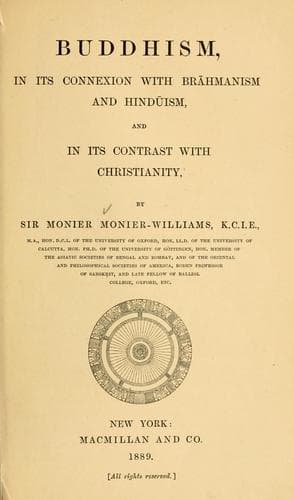
Buddhism, in Its Connexion with Brahmanism and Hinduism, and in Its Contrast with ChristianityMonier-Williams, Monier, Sir
Religion
Buddhism, in Its Connexion with Brahmanism and Hinduism, and in Its Contrast with Christianity
Monier-Williams, Monier, Sir
Buddhism; Buddhism -- Relations -- Christianity; Christianity and other religions -- Buddhism; India -- Religion
Addressing the assembled multitude, he said, ‘We ought to collect the
Law. Those who have kept it without failure, whose powers of
discrimination are clear, such persons may form the assembly. Those
who are only learners must depart to their homes.’
On this they went away, and only 999 men were left, including Ānanda.
But the great Kāṡyapa excluded Ānanda as being yet a learner.
Addressing him, he said, ‘You are not yet free from defect; you, too,
must leave the assembly. You were a personal attendant on Buddha, you
loved him much, and are, therefore, not free from the ties of
affection.’
So Ānanda retired to a desert place. Wearied out, he desired to lie
down. Scarcely had his head reached the pillow, when lo! he obtained
the condition of an Arhat. Then he returned to the door of the
assembly. But Kāṡyapa said to him, ‘Have you got rid of all ties? If
so, prove it; exercise your spiritual power and enter without the door
being opened.’ Then Ānanda entered through the key-hole, and having
paid reverence to the assembled monks, sat down.
This power of reducing the body to the size of an atom, so as to be able
to pass through so minute an aperture as a key-hole, was one of the
supernatural faculties supposed to belong to perfected saints or Arhats
(compare pp. 133, 245 of these Lectures).
The consideration of Buddhist Sacred Places might lead us on to various
hallowed spots in other Buddhist countries, for example, Anurādha-pura,
Adam’s Peak and Kelani in Ceylon; the site of the great pagoda at
Rangoon, and of that near Mandalay in Burma; the site of the Buddha’s
foot-print (Phra Bat) in Siam; the snows of Kinchinjunga in Sikkim; the
city of Lhāssa and its monasteries in Tibet; Kuren in Mongolia; but all
these, and other places, have either been incidentally mentioned in
previous Lectures or will be more fully noticed hereafter.
LECTURE XV.
_Monasteries and Temples._
Buddhist monasteries deserve a fuller notice than the incidental
allusions we have made to them in previous Lectures.
The duty of dwelling under trees, and not in houses, according to the
example set by all the Buddhas (see p. 136), and especially by Gautama
Buddha himself, during his long course of meditation (see p. 31), was in
theory supposed to be binding on all true monks. ‘The root of a tree for
an abode’ was one of ‘the four Resources,’ of which every monk was
allowed to avail himself, and the enumeration of which formed part of
the admission-ceremonies (see p. 80).
Public-domain text, read in full here on John Shaqi.
Reviews
Reviews
No reviews yet
Be the first to share your thoughts on this work.
Elsewhere in the archive
Join the Discussion
Join the discussion
Sign in to leave a comment or review.
Sign InorCreate an account