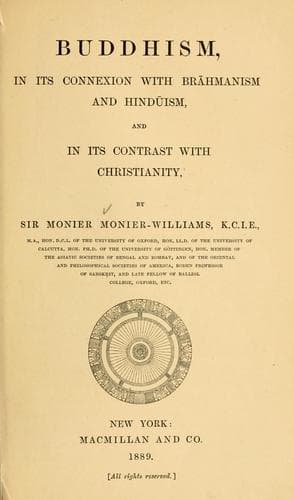
Buddhism, in Its Connexion with Brahmanism and Hinduism, and in Its Contrast with ChristianityMonier-Williams, Monier, Sir
Religion
Buddhism, in Its Connexion with Brahmanism and Hinduism, and in Its Contrast with Christianity
Monier-Williams, Monier, Sir
Buddhism; Buddhism -- Relations -- Christianity; Christianity and other religions -- Buddhism; India -- Religion
We passed by the foot of Tashi Lunpo, which is built on the lower
declivity of a steep hill. The roof of the palace is all of
copper-gilt. The building is of dark-coloured brick. The houses of the
town rise one above another. Four churches with gilt ornaments are
mixed with them. Altogether the town presents a princely appearance.
Many of the courts are spacious, flagged with stone, and have
galleries running round them. The alleys, which are likewise paved,
are narrow. The palace is appropriated to the Lāma and his officers,
to temples, granaries, warehouses, etc. The rest of the town is
entirely inhabited by priests, who are in number about four thousand.
The following is the substance of Mr. Bogle’s account of his interview
with the Tashi Lāma on November 8, 1774 (abbreviated from Markham’s
Tibet):—
In the afternoon I had my first audience of the Tashi Lāma. He is
about forty years of age, of low stature, and inclining to be fat. His
complexion is fairer than that of most Tibetans, and his arms are as
white as those of a European; his hair, which is jet black, is cut
very short; his eyes are small and black. The expression of his
countenance is smiling and good-humoured. He was upon his throne,
formed of wood carved and gilt, with some cushions above it, upon
which he sat with his legs folded under him. He was dressed in a
mitre-shaped cap of yellow broadcloth, with long bars lined with red
satin, a yellow cloth jacket without sleeves, and a satin mantle of
the same colour thrown over his shoulders. On one side of him stood
his physician, with a bundle of perfumed sandal-wood rods burning in
his hand; on the other stood his cup-bearer. I laid the Governor’s
presents before him, delivering the letter and the pearl necklace into
his own hands, together with a white handkerchief on my own part,
according to the custom of the country. He received me in the most
engaging manner. I was seated on a high stool covered with a carpet.
Plates of boiled mutton, boiled rice, dried fruits, sweetmeats, sugar,
bundles of tea, dried sheep’s carcases, etc., were set before me and
my companion, Mr. Hamilton. The Lāma drank two or three dishes of tea
with us, but without saying any grace, asked us once or twice to eat,
and on our retiring threw white handkerchiefs over our necks. After
two or three visits, he used to receive me without any ceremony, his
head uncovered, and dressed only in the large red petticoat worn by
all full monks, red boots, a yellow cloth vest, with his arms bare,
and a piece of coarse yellow cloth thrown across his shoulders. He sat
sometimes in a chair, sometimes on a bench covered with tiger-skins,
and nobody but the cup-bearer present. Sometimes he would walk with me
about the room, explain the pictures, or make some remarks upon the
colour of my eyes, etc. For, although venerated as God’s vicegerent
Public-domain text, read in full here on John Shaqi.
Reviews
Reviews
No reviews yet
Be the first to share your thoughts on this work.
Elsewhere in the archive
Join the Discussion
Join the discussion
Sign in to leave a comment or review.
Sign InorCreate an account