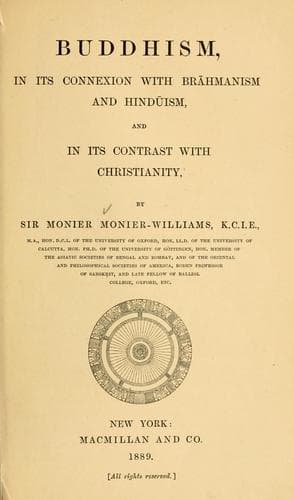
Buddhism, in Its Connexion with Brahmanism and Hinduism, and in Its Contrast with ChristianityMonier-Williams, Monier, Sir
Religion
Buddhism, in Its Connexion with Brahmanism and Hinduism, and in Its Contrast with Christianity
Monier-Williams, Monier, Sir
Buddhism; Buddhism -- Relations -- Christianity; Christianity and other religions -- Buddhism; India -- Religion
through all the eastern countries of Asia, and endowed with a portion
of omniscience and with many other divine attributes, he throws aside
in conversation all the awful part of his character, accommodates
himself to the weakness of mortals, endeavours to make himself loved
rather than feared, and behaves with the greatest affability to
everybody, particularly to strangers.
In 1783, when Tashi Lunpo was visited by Captain Turner, the monastery
consisted of 400 houses, many of which were built of stone and marble,
and at least two stories high. They contained about 3700 monks (now
3800). Around the houses were gilded temples, pinnacles, pyramidal
monuments (Stūpas), and above all the palace of the Tashi Lāma, forming
a striking spectacle.
Captain Turner had a remarkable interview with the Grand Lāma at the
neighbouring monastery of Terpaling, on December 4, 1783. He found the
princely child, then aged eighteen months, seated on a throne, with his
father and mother standing on the left hand. Having been informed that,
although unable to speak, he could understand, Captain Turner intimated
to him ‘that the Governor-General, on receiving news of his decease, had
been overwhelmed with sorrow, and continued to lament his absence from
the world until the cloud was dispelled by his re-appearance. The
Governor hoped that he might long continue to illumine the world by his
presence.’
The infant looked steadfastly at the British envoy, and appeared to be
listening to his words with deep attention, while he repeatedly nodded
his head, as if he understood every syllable. He was silent and sedate,
and conducted himself with astonishing dignity. Captain Turner thought
him one of the handsomest children he had ever seen. It seems that he
grew up to be an able and devout ruler, gratifying the Tibetans by his
presence for many years, and living to a good old age.
Tashi Lunpo was not visited by the French missionaries, but M. Huc
informs us (ii. 157) that in 1846 the then Panchen Lāma was 60 years of
age, and still vigorous. M. Huc was told that he was of Indian origin,
and that he had declared of himself that his first incarnation had taken
place in India some thousands of years before.
Mr. Sarat Chandra Dās, from whose notes of a journey in Tibet so many
extracts have been already given, writes thus of his arrival at Tashi
Lunpo on the 9th of December, 1881 (the extract is not given literally,
and is abbreviated):—
Public-domain text, read in full here on John Shaqi.
Reviews
Reviews
No reviews yet
Be the first to share your thoughts on this work.
Elsewhere in the archive
Join the Discussion
Join the discussion
Sign in to leave a comment or review.
Sign InorCreate an account