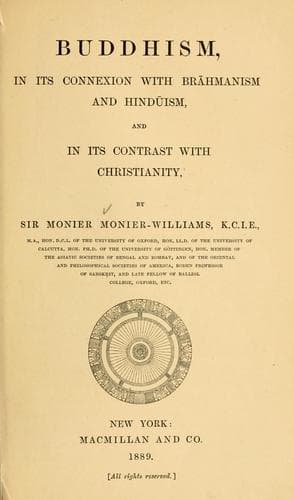
Buddhism, in Its Connexion with Brahmanism and Hinduism, and in Its Contrast with ChristianityMonier-Williams, Monier, Sir
Religion
Buddhism, in Its Connexion with Brahmanism and Hinduism, and in Its Contrast with Christianity
Monier-Williams, Monier, Sir
Buddhism; Buddhism -- Relations -- Christianity; Christianity and other religions -- Buddhism; India -- Religion
First, _Sam ye_ (Sam yas) is on the great river Tsanpo, about forty
miles from Lhāssa, in a south-easterly direction. It was the first
monastery founded in the eighth century by Padma-sambhava, after King
Khri Srong De Tsan’s restoration of Buddhism (pp. 271, 272). It is the
metropolitan monastery of the Red-capped monks and Urgyanpa sect. Sam ye
was visited by the Indian explorer Nain Singh in 1874, on his final
journey to Lhāssa[236], and by Sarat Chandra Dās in 1882. Many of its
images are of gold, and it possesses an extensive library.
Padma-sambhava was a master of Indian Yoga and magic. He is fabled to
have worked many miracles—such as filling empty jars with divine
water—at Sam ye. He undertook to expel all evil demons from Tibet, but
was opposed by the Bon priests.
The other chief monastery of the Red sect is that of _Sakya_ (Saskya),
situated about fifty-five miles from Tashi Lunpo, on the road leading in
a south-westerly direction towards Nepāl. It has four great sanctuaries
and a celebrated library, and is surrounded by a large town, with
temples and houses mostly painted red (p. 273).
It should be noted that in all the large monasteries of Northern
Buddhist countries, varied assortments of vestments, robes, costumes,
and masks are kept for use in the religious dances, masquerades, and
dramatic performances which are a characteristic of Northern Buddhism.
Indeed, some of the richer monasteries possess extensive wardrobes of
great value, and the monks in their masquerading dances change their
costumes very frequently and with great rapidity (see pp. 347-350).
Note, too, that the libraries of such monasteries generally contain
large and valuable collections of books. The 108 volumes of the northern
canon called Kanjur, with the commentaries called Tanjur (see p. 272),
constitute a library in themselves. In addition to these, there are vast
numbers of other treatises written to elucidate the mysteries of
Northern Buddhism, most of which are still a terra incognita to European
scholars. It is well known that in mediæval times some Buddhist
monasteries became seats of learning, which might have vied with the
most learned Universities established at that period in Europe.
_Temples._
Although temples have been already adverted to as forming an important
feature in all monasteries, and often an actual part of the edifice
constituting the monastery; it will be worth while to devote a short
space of time to their separate consideration.
In the earliest days of Buddhism neither temples nor halls nor rooms for
meeting together (saṅgha-gṛiha) were much needed. The monk recited the
Law in the open air or in the houses of the laity. It was only when
collections of monks crystallized into regularly organized communities,
and a kind of congregational recitation of the Law became a part of
every day’s duty, that the monks required places of assembly like
churches for the performance of religious services.
Public-domain text, read in full here on John Shaqi.
Reviews
Reviews
No reviews yet
Be the first to share your thoughts on this work.
Elsewhere in the archive
Join the Discussion
Join the discussion
Sign in to leave a comment or review.
Sign InorCreate an account