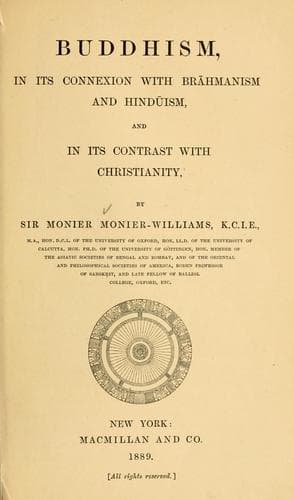
Buddhism, in Its Connexion with Brahmanism and Hinduism, and in Its Contrast with ChristianityMonier-Williams, Monier, Sir
Religion
Buddhism, in Its Connexion with Brahmanism and Hinduism, and in Its Contrast with Christianity
Monier-Williams, Monier, Sir
Buddhism; Buddhism -- Relations -- Christianity; Christianity and other religions -- Buddhism; India -- Religion
In the afternoon we arrived at Tashi Lunpo. In front of the western
entrance I noticed two Chortens (that is, ‘Ćaityas or Stūpas,’ see p.
504 of these Lectures), one very large, with a gilt spire, and the
other small. On entering the grand monastery, I mustered all my
knowledge of Buddhist ceremonies and monkish etiquette, that I might
not be criticised by the passing monks as one unacquainted with the
duties of the wearers of the sacred costume. I walked slowly and with
gravity, but secretly observing everything around me. There were a few
yaks under the charge of three or four herdsmen, waiting probably for
the return of some of their number from within the monastery. Some
monks, riding on mules, passed us from north to south. A few parties
with heavy grain packages on their backs were entering the monastery
along with us. The rays of the sun, now slanting on the gilded spires
of houses and tombs in the monastery, presented a very magnificent
view to the eye.
While residing in the monastery I saw people busily engaged in
out-door work, such as collecting fuel and tending cattle. In fact,
this was the busiest part of the year, when the Tibetans remain on the
move for the purpose of buying and selling, at a time when the
intensely cold winds wither up the vegetation, freeze the streams,
harden the soil, and dry up the skin. The monks, like the lay-people,
are remarkable for their habit of early rising. No monk within the
walls of the monastery rose later than five in the morning, and the
usual time for getting up was four a. m. Those who slept later,
without any special cause, were subject to correction. At three in the
morning the great trumpet summons all the monks to the religious
service in the congregation hall. Whoever fails to attend is punished
next morning. No register is kept, yet the officer who superintends
the discipline can tell what monk out of two thousand has absented
himself on any particular day. I was the only man who slept up to six
in the morning. The monks used often to remark that, were I a regular
monk of the monastery, the superintendent’s birch would have stript my
body of its flesh.
About six miles from Tashi Lunpo, and on the road leading from it in a
south-westerly direction towards the monastery of Sakya (see below), is
the monastery of _Narthang_, whence issued one of the three copies of
the Kanjur (p. 272) brought to Europe by Brian Hodgson.
We have now to notice the two most important monasteries of the Red
sect.
Public-domain text, read in full here on John Shaqi.
Reviews
Reviews
No reviews yet
Be the first to share your thoughts on this work.
Elsewhere in the archive
Join the Discussion
Join the discussion
Sign in to leave a comment or review.
Sign InorCreate an account