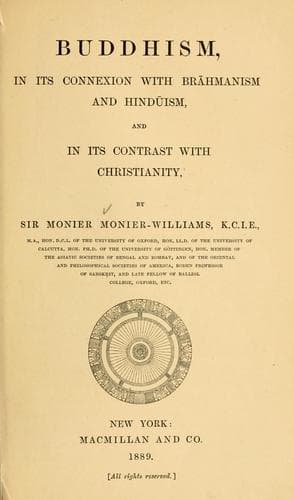
Buddhism, in Its Connexion with Brahmanism and Hinduism, and in Its Contrast with ChristianityMonier-Williams, Monier, Sir
Religion
Buddhism, in Its Connexion with Brahmanism and Hinduism, and in Its Contrast with Christianity
Monier-Williams, Monier, Sir
Buddhism; Buddhism -- Relations -- Christianity; Christianity and other religions -- Buddhism; India -- Religion
The five above-named reflections are—1. on the thirty-two impurities of
the body; 2. on the duty of displaying love (Maitrī) towards all beings;
3. on compassion for all who suffer; 4. on rejoicing with all who
rejoice; 5. on absolute indifference (upekshā) to joy or sorrow. These
contemplations (bhāvanā) in Buddhism take the place of prayer. The last
is the highest. The first is also a Sati-paṭṭhāna (p. 49). They must not
be confused with the meditations (Dhyānas, p. 209).
Then come six (or ten) transcendent virtues called Pāramitās, ‘leading
to the further shore,’ for Arhats. These, too, every Bodhi-sattva had to
practise before he could attain Buddhahood. They were:—1. Generosity or
giving (Dāna) to all who ask, even the sacrificing of limbs or life for
others; this is most important; 2. Virtue or moral conduct (Ṡīla); 3.
Patience or tolerance (Kshānti); 4. Fortitude or energy (Vīrya); 5.
Suppression of desire (Nekkhamma = naishkāmya), or, according to some,
profound contemplation; 6. Transcendental wisdom (Pañña = Prajñā). To
which are added—7. Truth (Satya); 8. Steadfast resolution (Adhishṭhāna);
9. Good-will or kindness (Maitra); 10. Absolute indifference or
imperturbability or apathy (Upekshā), resulting in a kind of ecstatic
quietude.
This kind of memorial tabulation in lists of 4, 5, 7, 8, 10, etc., is of
course a product of later Buddhism.
I now give examples from the Dharma-pada:—
‘By oneself is evil done; by oneself is one injured; by oneself is evil
left undone; by oneself is one purified; no one purifies another.’
(Compare Manu IV. 240.)
‘Better than dominion over the earth, better than going to Heaven, or
having sovereignty over the worlds, is the attainment of the first step
in sanctification.’
‘Not to commit evil, to accumulate merit by good deeds (kusalassa
upasampadā), to purify the heart, this is the doctrine of the
Enlightened’ (165, 178, 183).
‘As a frontier town is guarded[52] within and without, so guard
thyself.’ (Dh. 315.)
‘He who holds back rising anger like a rolling chariot, him I call a
real driver; any other merely holds the reins.’ (Dh. 222. Compare Manu
II. 88.)
‘Let a man overcome anger by gentleness, let him overcome the evil by
good; the parsimonious by liberality, the liar by truth.’ (Dh. 223. Manu
VI. 47, 48.)
‘The fully enlightened finds no satisfaction even in heavenly pleasures;
but only in suppression of desires.’
‘One by one, little by little, moment by moment, a wise man frees
himself from personal impurities as a refiner blows away the dross of
silver.’ (Dh. 187, 239.)
‘There is a treasure laid up in the heart, a treasure of charity,
purity, temperance, soberness. A treasure, secure, impregnable, that no
thief can steal; a treasure that follows after death. (Compare Manu IV.
241.) Universal science, all the perfections, supernatural knowledge,
supreme Buddhaship itself this treasure can procure.’ (Childers’
Nidhi-kāṇḍa.)
Public-domain text, read in full here on John Shaqi.
Reviews
Reviews
No reviews yet
Be the first to share your thoughts on this work.
Elsewhere in the archive
Join the Discussion
Join the discussion
Sign in to leave a comment or review.
Sign InorCreate an account