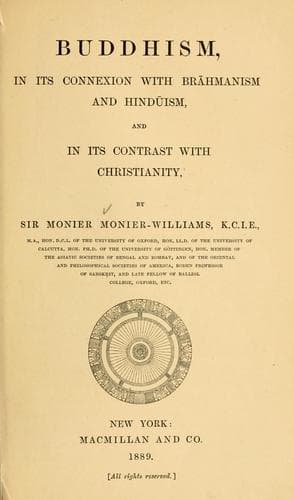
Buddhism, in Its Connexion with Brahmanism and Hinduism, and in Its Contrast with ChristianityMonier-Williams, Monier, Sir
Religion
Buddhism, in Its Connexion with Brahmanism and Hinduism, and in Its Contrast with Christianity
Monier-Williams, Monier, Sir
Buddhism; Buddhism -- Relations -- Christianity; Christianity and other religions -- Buddhism; India -- Religion
The following are some of the blessed states described in the
Mahāmaṅgala-sutta. They prove that Gautama required married men to
discharge their duties faithfully.
‘The succouring of mother and father, the cherishing of child and wife,
and the following of a peaceful calling, this is the greatest blessing’
(maṅgalam uttamam).
‘The giving alms, a religious life, aid rendered to relations, blameless
acts, this is the greatest blessing.’
‘Reverence and humility, contentment and gratefulness, the hearing of
the Law at the right time, this is the greatest blessing.’
‘Patience and lowly speech, association with religious men, recitation
of the Law at the right time, this is the greatest blessing.’
‘Self-mortification and chastity, discernment of the noble truths,
perception of Nirvāṇa, this is the greatest blessing.’
In the Aṅguttara (II. iv. 2) it is said that no adequate return can be
made by children to parents ‘even by menial service.’ With Gautama, to
honour father and mother was better than to worship the gods of heaven.
Many other examples might be given. Not only was a man forbidden to
kill, he was never to injure.
Then in the Rājovāda Jātaka we have the story of the one king ‘who
overcomes the strong by strength, the soft by softness, the good by
goodness, and the wicked by wickedness;’ and of the other king ‘who
conquers anger by calmness, the wicked by goodness, the stingy by gifts,
the liar (alika-vādinam) by truth.’
Other precepts require a man to exercise charity and respect towards all
aged persons, teachers, servants, and animals. He was to set an example
of self-sacrifice.
It is recorded of Gautama Buddha that on one occasion he plucked out his
own eyes, and that on another he cut off his own head, and that on a
third he cut his own body to pieces to redeem a dove from a hawk.
Yet we repeat that with all this apparently sublime morality no true
idea of sin, as displeasing to a Holy God, was connected with the
infraction of the moral code. Nor did a Buddhist always avoid harming
others from any true reverence for life. He was to cherish the life of
others, but his chief motive was the fear that by not doing so he would
entail the misery of continuous life on himself; and his chief motive
for avoiding anger was that it was incompatible with that equanimity,
which ought to characterize every wise man who aimed at the extinction
of his own personality.
Public-domain text, read in full here on John Shaqi.
Reviews
Reviews
No reviews yet
Be the first to share your thoughts on this work.
Elsewhere in the archive
Join the Discussion
Join the discussion
Sign in to leave a comment or review.
Sign InorCreate an account