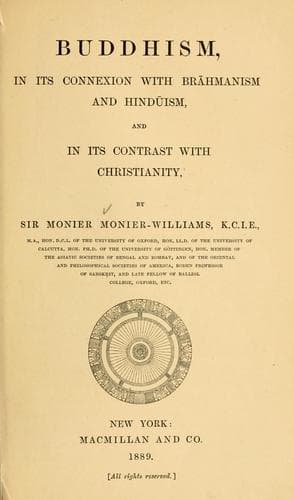
Buddhism, in Its Connexion with Brahmanism and Hinduism, and in Its Contrast with ChristianityMonier-Williams, Monier, Sir
Religion
Buddhism, in Its Connexion with Brahmanism and Hinduism, and in Its Contrast with Christianity
Monier-Williams, Monier, Sir
Buddhism; Buddhism -- Relations -- Christianity; Christianity and other religions -- Buddhism; India -- Religion
Now with regard to the Nirvāṇa of Arhatship, no one can have come in
contact with the natives of India in their own country, without
observing that for a genuine aristocratic Brāhman to allow others to see
him give way to any passion, to exhibit any emotion or enthusiasm, is
regarded as a proof of weakness.
We can easily understand, therefore, that when the Buddha exhorted his
followers to strive after a wholly impassive condition, he addressed a
sympathetic audience.
Long before his exhortations were heard in India, his fellow-countrymen
held persons in the highest respect who claimed to have entirely
suppressed their passions. The only peculiarity in Gautama’s teaching
was that he made this object incumbent on all true Buddhists alike,
without exception. And this state of absolute imperturbability is well
indicated to the eye by the usual attitude of the images which, after
Gautama’s death, were carved to represent him—an attitude of passionless
composure, and dignified calm.
In the interesting Pāli work Milinda-praṡna (Milinda-pañho), containing
a conversation on the subject of Nirvāṇa between King Milinda (Menander)
and the monk Nāgasena (supposed to have lived about 140 B.C.), the
latter compares it to the pure water which quenches fire, and to the
fathomless Ocean freed from trouble and impurities, which no river,
however vast, can fill to overflowing; and to the Air, which cannot be
seen or explained, though it enters our bodies and fills us with life;
and to Space, which is eternal and infinite, and beyond the power of man
to conceive.
I trust I shall not shock my Indian friends if I illustrate this
condition by a comparison of my own drawn from the animal creation. In
crossing the Indian Ocean, when unruffled by the slightest breeze, I
have sometimes observed a jelly-fish floating on the surface of the
transparent water, apparently lifeless. The creature is evidently
neither asleep nor awake. It certainly is not thinking about anything,
and its consciousness is doubtful. All that can be affirmed about it is
that it seems to be drinking in the warm fluid in a state of lazy
blissful repose.
No Buddhist, at least, could look at such a sight without being reminded
of this idea of Nirvāṇa—the idea of, so to speak, floating in perfect
repose and peace and cessation from all pain, and all work, and even all
thought, on a kind of ocean of half conscious, half unconscious
beatitude. It is not consciousness, neither is it unconsciousness. It is
symbolized by a full-blown, perfectly formed lotus—a frequent emblem of
perfection—reposing on a calm mirror-like lake.
With regard to Pari-nirvāṇa[61]—the complete termination of migrations
and passing away of all the elements of bodily existence—if this is to
be distinguished from the Brāhmanical idea of absorption into an
impersonal spirit—whereby the Ego of personal identity is destroyed—it
is a distinction without much difference.
Public-domain text, read in full here on John Shaqi.
Reviews
Reviews
No reviews yet
Be the first to share your thoughts on this work.
Elsewhere in the archive
Join the Discussion
Join the discussion
Sign in to leave a comment or review.
Sign InorCreate an account