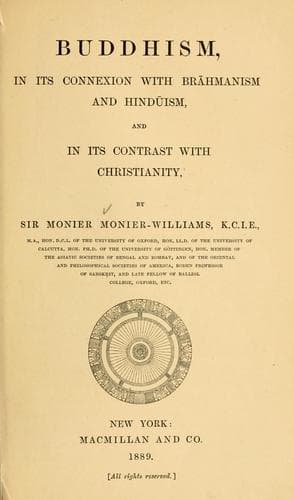
Buddhism, in Its Connexion with Brahmanism and Hinduism, and in Its Contrast with ChristianityMonier-Williams, Monier, Sir
Religion
Buddhism, in Its Connexion with Brahmanism and Hinduism, and in Its Contrast with Christianity
Monier-Williams, Monier, Sir
Buddhism; Buddhism -- Relations -- Christianity; Christianity and other religions -- Buddhism; India -- Religion
Strictly, however, in Buddhism the dissolution of the body leaves no
surviving personality or individuality, and consequently Pari-nirvāṇa is
not properly described either as absorption into a void (ṡūnya) or as
annihilation. It is simply the absolute termination of a series of
conscious bodily organizations. The Buddha himself evaded dogmatic
definitions, and would probably have said:—it is not life, neither is it
non-life; it may be compared to infinite space (ṡūnya) which is not to
be comprehended or explained.
We should also bear in mind that although Nirvāṇa and Pari-nirvāṇa
constitute the ultimate goal to which all the morality of a true
Buddhist tends, they have no place either in the aims or thoughts of the
ordinary adherents of Buddhism at the present day.
The apex of all the desires, the culminating point of all the ambition
of the most religiously-minded Buddhists of modern times, points to a
life in one of the heavens, while the great mass of the people aim only
at escaping one of the hells, and elevating themselves to a higher
condition of bodily existence in their next birth on this earth, and
perhaps on that very part of this earth which is the scene of their
present toils, joys, and sorrows.
It only remains for me to caution those who may be impressed with the
beauty of some of the precepts of the moral code and its theory of
perfection, as ending in Pari-nirvāṇa, against deducing therefrom too
optimistic an estimate of the Buddhist system. Buddhist morality is like
a showy edifice built on the sand. It is a thoroughly fair-weather
structure, incapable of standing against flood, storm, and tempest.
It may be summed up in a few words as a scheme for the establishing of a
paradox—for the perfecting of one’s self by accumulating merit with the
ultimate view of annihilating all consciousness of self—a system which
teaches the greatest respect for the life of others, with the ultimate
view of extinguishing one’s own.
It must, in short, be clearly understood that if any comparison be
instituted between Buddhism and Christianity in regard to the
self-abnegation, or self-sacrifice which each claims to inculcate, the
self to be got rid of in Buddhism is not the selfishness condemned by
Christianity, but rather the self of individuality—the self of
individual life, and personal identity.
To be righteous in a Christian sense a man must be God-like, and to be
righteous in a Buddhistic sense a man must be Buddha-like; but the
righteousness of the Buddhist is not the perfection of holiness by the
extinction of sin committed against God, but the perfection of
merit-making, with the view of earning happiness for himself in a higher
state hereafter.
For every Buddhist is like a trader who keeps a ledger, with a regular
debtor and creditor account, and a daily entry of profit and loss.
Public-domain text, read in full here on John Shaqi.
Reviews
Reviews
No reviews yet
Be the first to share your thoughts on this work.
Elsewhere in the archive
Join the Discussion
Join the discussion
Sign in to leave a comment or review.
Sign InorCreate an account