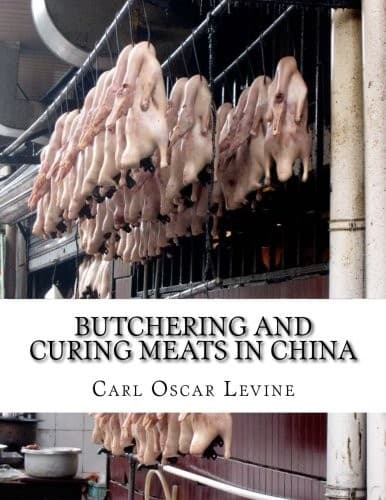
Butchering and curing meats in ChinaLevine, Carl Oscar
Science
Butchering and curing meats in China
Levine, Carl Oscar
Meat -- Preservation; Slaughtering and slaughter-houses -- China
The skins of cattle represent considerable value if properly treated.
To save them in the north where cold weather prevails during the
butchering season is not difficult, as they can be rolled up and kept
frozen until disposed of. However, in the warm seasons, they should be
spread out flat, hair side down, the legs, flanks, etc. stretched, and
all parts rubbed thoroughly with salt. Particular pains should be
taken to treat the entire surface of the skin. If more than one skin
is to be salted, they should be salted one at a time and should be
spread one on top of the other, with the hair sides together, and the
skin sides together. Where only one hide is handled, the legs and head
should be folded in and the hide rolled up. Enough salt should be used
to cure the hide thoroughly if it is to be kept for any length of
time. Ten to twelve pounds of salt will be sufficient for an ordinary
hide.
Killing and Dressing Sheep
Much of the sheepy flavor of mutton comes from the generation of
gases in the stomach after the sheep is killed. For this reason, the
sheep should always be dressed as rapidly as possible. A platform
about eighteen inches high is convenient to work on and aids in
keeping the blood away from the body, insuring a cleaner carcass. A
clean, dry place is necessary for neat work. Water or blood on the
wool makes it very difficult to dress the animal nicely.
§ 30. Stunning and Bleeding
If the sheep is an old one, it may be stunned before bleeding. If a
young one, the same purpose is served by dislocating the neck. This is
accomplished by putting one hand on top of the head or poll and the
other hand under the chin and giving a sharp twist upward. Then lay
the sheep on its side on the platform, with its head hanging over one
end. Grasp the chin in the left hand and stick a knife through the
neck just back of the lower jaw. The cutting edge of the knife should
be turned to the spinal column and the cut be made through the flesh
to the bone. In this way it is possible to sever the blood vessels
without cutting the windpipe.
§ 31. Skinning
Public-domain text, read in full here on John Shaqi.
Reviews
Reviews
No reviews yet
Be the first to share your thoughts on this work.
Join the Discussion
Join the discussion
Sign in to leave a comment or review.
Sign InorCreate an account