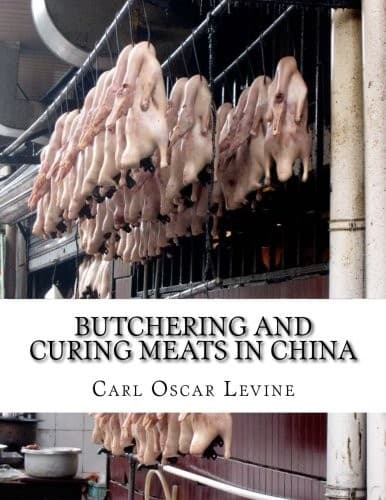
Butchering and curing meats in ChinaLevine, Carl Oscar
Science
Butchering and curing meats in China
Levine, Carl Oscar
Meat -- Preservation; Slaughtering and slaughter-houses -- China
This bulletin discusses the different methods, both Chinese and
foreign, of butchering and curing meats. The aim has been to present
the material in a practical way so as to be of value to the general
public as well as of special service in connection with the courses in
Meats offered at the Canton Christian College.
The writer realizes that this bulletin is not complete, in that the
subject, especially in regard to curing meats in different parts of
China, is far from exhausted. However, it is thought best to publish
in this form, and in a later edition to include additional material
which may be secured on the subject. Constructive criticism on this
bulletin will be received gladly.
The writer is especially indebted to the United States Department of
Agriculture for permission to use material from its publications.
Special acknowledgment is also due to Mr. Taam Sik Hung and Mr. W. L.
Funkhouser of the agricultural staff of the Canton Christian College,
who have made valuable suggestions in the preparation of the
manuscript, to agricultural students who have taken the course in
Meats under the writer’s supervision and have assisted in securing the
data on Chinese methods of curing meats, and to Mr. A. H. Holt,
Instructor of English in Canton Christian College, for his assistance
in reading the manuscript.
C. O. Levine
Butchering and Curing Meats in China
Introduction
The Chinese, like most people, are lovers of pork, beef, mutton, and
poultry, and consume these meats, both fresh and cured, in large
quantities each year.
Fresh meat is practically all consumed within a few miles of the
locality in which it is butchered. However large quantities of cured
meats, especially cured pork and duck, are shipped long distances from
the localities where they are cured. Cured hams and bacon are shipped
from Kuling north to Peking, and south to Canton. Yunnan exports to
Canton and other parts of China, to the Philippine Islands and other
countries to the south, a considerable quantity of home cured ham,
which is quite popular with the Chinese in those regions. On the other
hand, a good deal of cured ham and bacon is imported, chiefly from
Australia and England, to the various ports of China and finds its way
inland.
For a number of years Canton Christian College has been studying the
butchering and curing problems as they exist in southern China,
particularly in the region of Canton. Meats of various kinds have
been butchered and cured by the College. Both the foreign and
Chinese methods of handling the meat have been practiced and
studied. In this work special attention has been given to the
butchering and curing of pork.
Public-domain text, read in full here on John Shaqi.
Reviews
Reviews
No reviews yet
Be the first to share your thoughts on this work.
Join the Discussion
Join the discussion
Sign in to leave a comment or review.
Sign InorCreate an account