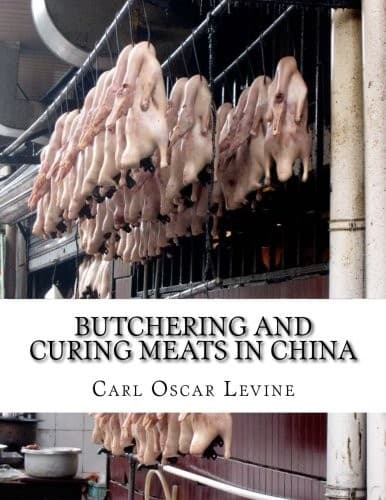
Butchering and curing meats in ChinaLevine, Carl Oscar
Science
Butchering and curing meats in China
Levine, Carl Oscar
Meat -- Preservation; Slaughtering and slaughter-houses -- China
Put the flour in the water, dissolving all lumps thoroughly. Dissolve
the chrome in a quart of water in a separate vessel, and add the
solution and the glue to the flour and water. Bring the whole to a
boil, and add the barytes slowly, stirring constantly. Make the wash
the day before it is required. Stir it frequently when using, and
apply with a brush.
Chinese Meat Recipes
§ 62. Bean Sauce Sausage (_Laap Ch’eung_ 腊腸).
Sausage is a very popular meat with the Chinese, especially during the
winter season. It is probably the most widely used of all cured meats,
although as a rule it is quite expensive compared with other meats.
§ 63. Pickle for Bean Sauce Sausage
For every catty of meat, use:
Saltpeter (_siu_ 硝) 1 mace[2] (_ts’in_ 一錢)
Salt (_shuk im_ 熟鹽) 3 mace (_ts’in_ 三錢)
Sugar (_ping fa t’ong_ 冰花糖) 2 mace (_ts’in_ 二錢)
First-drawn bean sauce (_t’au ch’au yau_ 頭抽油) 2 mace
Raw bean sauce (_shang ch’au yau_ 生抽油) 1 mace
Mixture of spices (_ng heung fan_ 五香粉) 1 mace
The mixture of spices is made up of the following:
Red pepper (_ch’un tsiu_ 春椒) 10 mace
Ground anise seed (_taai wui_ 大回) 10 mace
Cloves (_ting heung_ 丁香) 10 mace
Cinnamon (_yuk kwai_ 玉桂) 10 mace
These spices should be purchased separately and never ready mixed, as
ready made mixtures are often worthless.
Sometimes two orange peelings, finely cut or ground, fresh or dried
are used for every ten catties of meat. Two mace of double distilled
wine (_sheung ching tsau_ 雙蒸酒), or treble distilled wine (_saam ching
tsau_ 三蒸酒), and a wine called (_fan tsau_ 汾酒), are sometimes added
for each catty of meat. The wine helps preserve the meat.
The above spices should be carefully mixed and the mixture thoroughly
stirred into the meat. In mixing the spices the usual method is to use
the hands as mixers. A better way is to use a large spoon, or some
similar utensil.
§ 64. Preparation of the Meat for Sausage
Use hams, shoulders, chops, fat back, and neck. Sometimes the liver is
added to give a dark color. No belly meat or tough parts should be
used. Separate the lean from the fat meat. Chop into pieces about
one-quarter inch in diameter, or run through a sausage mill. One part
fat and one part lean meat is generally used, though the proportion
may vary either way, to suit the taste and demand.
§ 65. Sausage Casing (_Ch’eung I_ 腸衣)
Sausage casing is generally made from the middle coat of the small
intestines of sheep although it is also made from the intestines of
the hog. The casing is very thin and transparent. Some casing is
prepared in Canton, but most of what is used in Canton comes from
Shanghai, as there are comparatively few sheep or goats slaughtered in
Canton. The dried casing sells for $3.00 to $6.00 a catty.
§ 66. Softening the Casing
Public-domain text, read in full here on John Shaqi.
Reviews
Reviews
No reviews yet
Be the first to share your thoughts on this work.
Join the Discussion
Join the discussion
Sign in to leave a comment or review.
Sign InorCreate an account