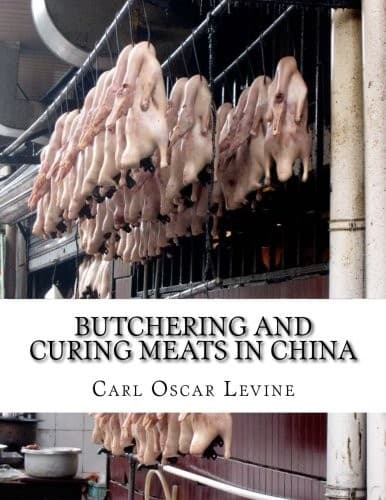
Butchering and curing meats in ChinaLevine, Carl Oscar
Science
Butchering and curing meats in China
Levine, Carl Oscar
Meat -- Preservation; Slaughtering and slaughter-houses -- China
Poultry, or pigs weighing up to one hundred catties, frequently are
roasted. Two methods are used. Poultry and small pigs may be roasted
in pans in an ordinary oven. The other method, which is the one
commonly used, is to roast in a special oven. The latter method
requires more skill than roasting in the ordinary oven. The oven is in
the form of a cylinder stood on end, thirty to forty inches in
diameter, and five or six feet high. The poultry or pig is hung on
iron bars across the top of the stove, and the stove or oven is then
covered with an iron lid. Fire is built at the bottom of the cylinder
through an opening at one side. Dry hard wood or charcoal, which
give but little smoke, are generally used for fuel. The meat being
roasted needs constant attention and shifting so that it will roast
through uniformly. It is said that when the meat gives off a white
smoke, it is an indication that it is done. A solution made up of one
part honey and one part water is rubbed on the meat, both inside and
outside the carcass, before the roasting. This honey solution gives
the outside of the meat a desirable rich reddish brown color when
roasted.
§ 84. Dried Duck (_Laap Aap_ 腊鴨)
For one dressed bird, use five taels of salt, which should be well
rubbed into the meat. Then pack in salt for one day. Take up, wash off
the salt, and put between two bamboo mats. Apply pressure for a few
days, and hang up to dry.
The Canton climate is not very favorable for drying duck, as during
the meat curing season it frequently rains. If the meat does not dry
fairly rapidly, it is likely to spoil. In Naam On, Kwong Sai province,
where it is generally dry during the curing season, the ducks are
packed away after two days exposure to the sun. In Canton, it often
takes two weeks. Ducks’ heads, kidneys, feet and other parts of the
bird are also cured in the same way.
§ 85. Puffed Pig Skin (_Chue P’ei_ 豬皮)
In making puffed pig skin, the pig skin is first cooked, and then
thoroughly scraped with a knife in order to remove the oil and fat. It
is then hung up in the sun to dry for about ten days. When it is ready
for the puffing or blistering process, which is accomplished by
roasting the dried skin in hot gravel in a shallow pan over a slow
fire This process whitens and puffs, or blisters, the skin.
The puffed pig skin is cut into small cubes and used in soups. It has
a spongy appearance with very little taste.
The skin on the hams, shoulders, and sides will puff the best, while
the skin on the back, legs, and belly will not puff well on roasting
in the hot gravel, but can be puffed by roasting in peanut oil.
On account of dampness and cloudy weather which interfere with proper
drying, puffed pig skin is best made during the dry, sunny winter
months. The product is on sale, however, throughout the year, as it
keeps well if hung in a fairly dry, airy place. It is commonly seen
hanging in the front of meat shops in Canton.
Public-domain text, read in full here on John Shaqi.
Reviews
Reviews
No reviews yet
Be the first to share your thoughts on this work.
Join the Discussion
Join the discussion
Sign in to leave a comment or review.
Sign InorCreate an account