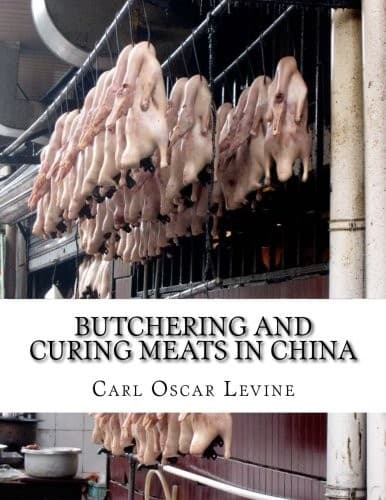
Butchering and curing meats in ChinaLevine, Carl Oscar
Science
Butchering and curing meats in China
Levine, Carl Oscar
Meat -- Preservation; Slaughtering and slaughter-houses -- China
The Chinese lard hogs are characterized by their large, pendulous
bellies, sway-backs, light hams, and by their slowness in maturing.
They are inferior hogs when compared with the improved breeds of
Europe and America, but as a rule are better than the native hogs
found in other parts of the Orient. Their large bellies and low backs
are largely due to the fact that from the time the pigs begin to eat
until they are butchered, all concentrate feeds are given in the form
of a very wet swill, and they are allowed to drink all they can hold
of such feed twice a day. Such feeding stretches the digestive tract
to an abnormal degree, and permanently enlarges the belly and pulls
down the back. By giving less water with the feed, and not allowing
the pigs to fill up with all they can possibly hold, this abnormal
development can largely be prevented. Intelligent breeding for several
generations, by mating animals with the most desirable conformation,
such as straight backs, wide, deep hams, long, deep bodies, short
heads, and short legs, should bring about further improvement.
Breeding for fast growing and early maturing animals should also be
practiced, as the most profitable feeding is with young animals.
[Illustration: Fig. 1. Heifer two years old of the native humped
variety]
[Illustration: Fig. 2. Beef-draft water buffalos with calves a few
weeks old]
[Illustration: Fig. 3. Chinese “fat-tailed” variety of sheep]
[Illustration: Fig. 4. Chinese lard hogs ready for butchering raised
at Canton Christian College]
It is interesting to note that years ago the native lard hog of
southern China was used to secure desirable characters in two of our
most important modern breeds, the Berkshire and the Poland China
breeds. However, since that time these western breeds have been
further greatly improved by intelligent selection and breeding, while
the Chinese hogs have been very little improved, if at all. To-day, in
comparing the native Chinese lard hog with the modern western breeds,
there is no resemblance in the Chinese hog to the wide, slightly
arched back, deep, long sides, deep, full hams, small heads, short
legs, and rapid growth of these modern breeds which have, in their
origin, blood of the native Chinese lard hog.
Due to slow maturity and undesirable conformation, the Chinese hog is
not as economical in converting feeds into meat as is the improved
western hog. However, the meat is of good flavor and can be
successfully cured. An exception to this is the case of animals that
have been largely fed on rice bran, which produces a soft, oily pork,
although no difficulty is experienced in curing such pork. Wheat bran
produces a firm flesh. If a firm flesh is desired, it is important
that rice bran or polish not be fed to hogs during the last six to
eight weeks of the fattening period.
§ 2. Cattle
Public-domain text, read in full here on John Shaqi.
Reviews
Reviews
No reviews yet
Be the first to share your thoughts on this work.
Join the Discussion
Join the discussion
Sign in to leave a comment or review.
Sign InorCreate an account