About twenty-five years ago I commenced investigating the history of
obsolete punishments, and the result of my studies first appeared in the
newspapers and magazines. In 1881 was issued "Punishments in the Olden
Time," and in 1890 was published "Old Time Punishments": both works were
well received by the press and the public, quickly passing out of print,
and are not now easily obtainable. I contributed in 1894 to the Rev.
Canon Erskine Clarke's popular monthly, the _Parish Magazine_, a series
of papers entitled "Public Punishments of the Past." The foregoing have
been made the foundation of the present volume; in nearly every instance
I have re-written the articles, and provided additional chapters. This
work is given to the public as my final production on this subject, and
I trust it may receive a welcome similar to that accorded to my other
books, and throw fresh light on some of the lesser known byways of
history.
WILLIAM ANDREWS.
THE HULL PRESS,
_August 11th, 1898._
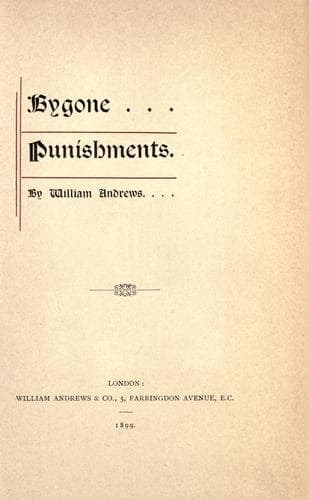
Bygone Punishments.
Hanging.
The usual mode of capital punishment in England for many centuries has
been, and still is, hanging. Other means of execution have been
exercised, but none have been so general as death at the hands of the
hangman. In the Middle Ages every town, abbey, and nearly all the more
important manorial lords had the right of hanging, and the gallows was
to be seen almost everywhere.
Representatives of the church often possessed rights in respect to the
gallows and its victims. William the Conqueror invested the Abbot of
Battle Abbey with authority to save the life of any malefactor he might
find about to be executed, and whose life he wished to spare. In the
days of Edward I. the Abbot of Peterborough set up a gallows at
Collingham, Nottinghamshire, and hanged thereon a thief. This proceeding
came under the notice of the Bishop of Lincoln, who, with considerable
warmth of temper, declared the Abbot had usurped his rights, since he
held from the king's predecessors the liberty of the Wapentake of
Collingham and the right of executing criminals. The Abbot declared that
Henry III. had given him and his successors "Infangthefe and Utfangthefe
in all his hundreds and demesnes." After investigation it was decided
that the Abbot was in the wrong, and he was directed to take down the
gallows he had erected. One, and perhaps the chief reason of the prelate
being so particular to retain his privileges was on account of its
entitling him to the chattels of the condemned man.
Public-domain text, read in full here on John Shaqi.
Reviews
Reviews
No reviews yet
Be the first to share your thoughts on this work.
Join the Discussion
Join the discussion
Sign in to leave a comment or review.
Sign InorCreate an account