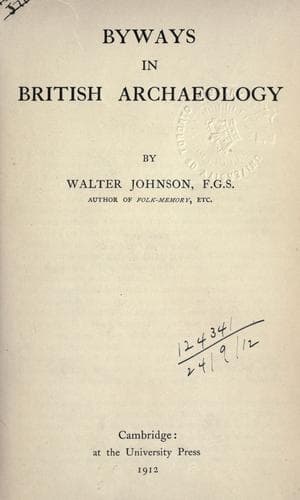
Christian antiquities -- Great Britain; Folklore -- Great Britain; Great Britain -- Antiquities
With respect to the burial feasts of the prehistoric period, the line of
descent might be easily traced. The funeral suppers given by the Greeks
and Romans to the relatives of a dead person are frequently referred to
by classical authors. Similar feasts are mentioned by our English
writers from the time of Robert de Brunne (fl. A.D. 1288-1338)
onwards[817]. Huge repasts--shall we not say orgies?--continued in
fashion until the eighteenth century at least. Brand relates that, at
the funeral of a Highland lord in 1725, not fewer than 100 black cattle
and 300 sheep were slain “for the entertainment of the company[818].”
Nowadays the feast has dwindled, in most localities, to a glass of wine
and a biscuit. But there have been some amazing exceptions. Canon
Atkinson, in the earlier years of his incumbency at Danby-in-Cleveland,
about the middle of the nineteenth century, found that the “funeral
bak’d meats” were held in high esteem. On the death of a villager of
importance, invitations were sent out “not merely by the score, but by
the hundred. I have myself counted,” he says, “more than three hundred
seated in the church on at least four, if not five, different occasions.
And the rule is, and, still more, was, that the preponderating majority
of these ‘went to the burial’ at the house where the corpse lay,
beginning at ten o’clock and continuing to drop in, according to
convenience or distance to be traversed, throughout the morning and
afternoon till it became time to ‘lift the body’ and make a start for
the church. And all these were fed--entertained, rather--at the house of
mourning, if it chanced to be that of one of the principal inhabitants.”
All day long there were relays of visitors, from a dozen up to a score,
smoking and drinking at the house[819]. During the latter part of the
entertainment glasses of wine were handed round, with crisp cakes,
colloquially known as “averils” or “averil bread[820].” Canon Atkinson
traced this word thus: _averil_, _avril_, then by transposition, _arvil_
or _arvel_ (= heir-ale). This “heir-ale,” or succession-ale, thus stands
for the feast at which the heirs drank themselves into their father’s
land. It is interesting to note that this etymology is supported by the
highest authorities--for example, by the _New Oxford Dictionary_.
Public-domain text, read in full here on John Shaqi.
Reviews
Reviews
No reviews yet
Be the first to share your thoughts on this work.
Elsewhere in the archive
Join the Discussion
Join the discussion
Sign in to leave a comment or review.
Sign InorCreate an account