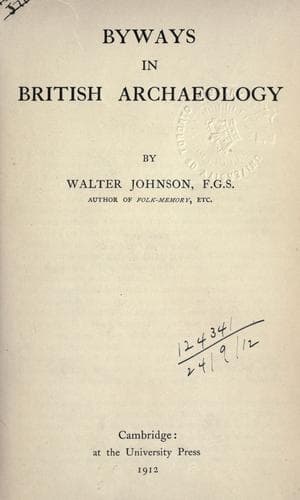
Christian antiquities -- Great Britain; Folklore -- Great Britain; Great Britain -- Antiquities
The magnetic compass, of which the history is a little uncertain (see p.
228, _supra_), may be put aside in our present inquiry, since it belongs
to a state of society of comparatively high development. The
unembellished teaching which is to be examined dates far earlier than
the birth of science in the Middle Ages, or the period of the
introduction of the magnetic needle into Europe. We shall find, however,
that the folk-lore of the Cardinal Points received many additions at the
hands of Mediaeval symbolists. The mythology of that epoch has, indeed,
been fitly compared to a complex alloy, formed by the blending of pure
ores from various sources. The traditions of previous ages were
retained, and blended, but new material was thrown into the crucible.
Certain patent facts would appeal even to the elementary minds of the
Stone Age men. These folk saw the sun rise daily in the East, traverse
the sky by way of the South, and finally set at evening in the West.
Birth and brightness were followed by ascendancy and power; the descent
led to disappearance and darkness. There was the dawn, followed by warm
beams which dispersed both gloom and vapour. The blue South yielded the
heat of noonday, at which time the sunbeams were genial, even in the
depth of winter. But when the dying sun had withdrawn for the day,
primitive men would experience discomfort and uneasy forebodings. This
disappearance of the great luminary, the lord and giver of life, was a
permanent mystery; the rebirth next morning was even more perplexing. At
a later period, the men of China and North America, of Greece and Rome,
evolved curious explanations of these phenomena, but at first only the
physical effects of the sun’s apparent movements would concern the
barbaric mind.
Very early in the growth of ideas man would learn that the position of
the sun was a good index of direction. It has been mooted whether the
most ancient method of denoting direction, that is, “orientation” in its
wider sense, was not to describe the speaker’s surroundings, or to
indicate natural features known to him and his fellows[833]. Thus, a
hunter might speak of a place by reference to some prominent rock or
tree; his direction might, in the same way, be told in terms of the
prevailing winds. One is nevertheless driven to believe that simple
observations of the sun’s position would be made almost as soon as man
began to take notice of any natural features or occurrences whatever; in
either case, any slight priority of method is of such trivial account as
to be negligible.
Public-domain text, read in full here on John Shaqi.
Reviews
Reviews
No reviews yet
Be the first to share your thoughts on this work.
Elsewhere in the archive
Join the Discussion
Join the discussion
Sign in to leave a comment or review.
Sign InorCreate an account