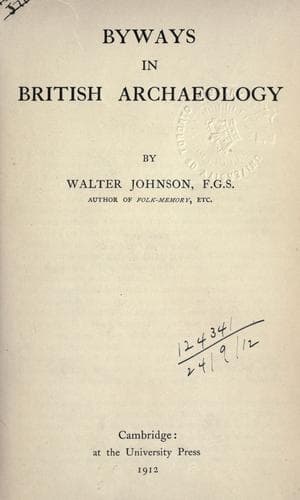
Christian antiquities -- Great Britain; Folklore -- Great Britain; Great Britain -- Antiquities
would be required. Often, as at Gumfreston, the church was the only
building strong enough to give adequate security to human beings and to
portable property. Castles do not exist everywhere, neither, indeed, do
these sturdy towers; but the one group seems to be largely complementary
to the other. Exception has also been taken to the evidential value of
the narrow window openings. Mr Allcroft, while expressing agreement with
the theory that ecclesiastical towers were frequently employed for
protection, deprecates an appeal to these narrow slits as affording
satisfactory testimony[293]. He contends that the openings were made
strait and were provided with an inner splay to minimize draughts. That
they would be moderately efficient for this purpose may be conceded. Not
only the ordinary current of air, but the high gale, had to be foreseen
and provided against. Glazing the apertures was out of the question, in
the early times when glass was a costly article, especially in remote
counties. But there is another mode of approaching the question. What
was the purpose of the well-known “oillets” in buildings purely
defensive? Even in primitive warfare no tower was impregnable if it
presented wide openings to the foe. Arrows and slingstones would, under
certain conditions, prove more swift and deadly agents than fire itself.
We may grant that the round-headed twin aperture, with its single plain
baluster-shaft in the middle, so familiar in the late Saxon towers of
England, was not avowedly of a defensive character. That admission does
not exclude a belief in the defensive value of the narrow window. During
the Perpendicular period a tiny battlemented parapet was frequently used
for the ornamentation of a capital or transom, but such a practice does
not negative the original use of the battlement in fortification.
Further it might be reasonably argued that the strait window-opening was
copied from secular strongholds because it originally served one purpose
in all cases. The point is not of prime importance, but it is worthy of
note that the narrow loophole continued to prevail after glass had come
into general use for church windows, and after bells had become common.
The price of glass was, therefore, not the deterrent. Again, the
bell-ringer would perhaps have actually welcomed a wider opening.
Whatever may have been the motive, we find that, from the Early English
period onward, the tiers of spire lights known as dormer window’s or
lucarnes, though mainly decorative in character, continued to be made
very narrow. On the other hand, these dormers were so arranged that one
series was placed, with respect to the group above or below, on
alternate sides of the spire. One fact remains; in towers which were
designed to withstand attack, the retention, if not the initiation, of
the narrow type of opening, suggests motives of strategy.
Public-domain text, read in full here on John Shaqi.
Reviews
Reviews
No reviews yet
Be the first to share your thoughts on this work.
Elsewhere in the archive
Join the Discussion
Join the discussion
Sign in to leave a comment or review.
Sign InorCreate an account