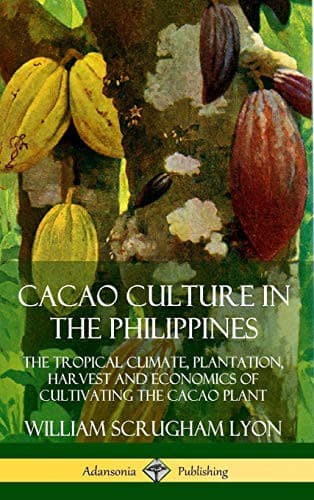
Cacao Culture in the PhilippinesLyon, William Scrugham
Science
Cacao Culture in the Philippines
Lyon, William Scrugham
Cacao
Irrigation must be resorted to in cases of deficient or unevenly
distributed rainfall, and irrigation is always advantageous whenever
there is suspension of rain for a period of more than fifteen days.
Concerning temperatures the best is that with an annual mean of 26°
to 28°, with 20° as the mean minimum where any measure of success
may be expected. A mean temperature of over 30° is prejudicial to
cacao growing.
The last but not least important of the atmospheric phenomena for
our consideration are the winds. Cacao loves to "steam and swelter in
its own atmosphere" and high winds are inimical, and even refreshing
breezes are incompatible, with the greatest success. As there are but
few large areas in these Islands that are exempt from one or other
of our prevailing winds, the remedies that suggest themselves are:
The selection of small sheltered valleys where the prevailing winds
are directly cut off by intervening hills or mountains; the plantation
of only small groves in the open, and their frequent intersection by
the plantation of rapid growing trees; and, best of all, plantings
made in forest clearings, where the remaining forested lands will
furnish the needed protection.
LOCATION.
It is always desirable to select a site that is approximately level
or with only enough fall to assure easy drainage. Such sites may
be planted symmetrically and are susceptible to the easiest and
most economical application of the many operations connected with
a plantation.
Provided the region is well forested and therefore protected from
sea breezes, the plantation may be carried very near to the coast,
provided the elevation is sufficient to assure the grove immunity from
incursions of tide water, which, however much diluted, will speedily
cause the death of the plants.
Excavations should be made during the dry season to determine that
water does not stand within 1 1/2 meters of the surface, a more
essential condition, however, when planting is made "at stake" than
when nursery reared trees are planted.
Hillsides, when not too precipitous, frequently offer admirable shelter
and desirable soils, but their use entails a rather more complicated
system of drainage, to carry away storm water without land washing,
and for the ready conversion of the same into irrigating ditches during
the dry season. Further, every operation involved must be performed
by hand labor, and in the selection of such a site the planter must
be largely influenced by the quantity and cost of available labor.
Public-domain text, read in full here on John Shaqi.
Reviews
Reviews
No reviews yet
Be the first to share your thoughts on this work.
Join the Discussion
Join the discussion
Sign in to leave a comment or review.
Sign InorCreate an account