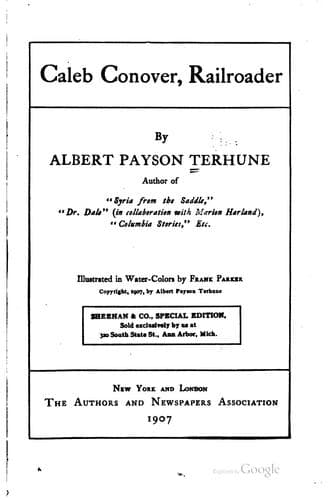
American fiction -- 20th century; Political fiction; Railroad stories; West (U.S.) -- Fiction
Caleb, colder, harder, less human than ever, gave no outward sign of the
silent warfare that had torn him during that study-fire vigil on the
night of Anice Lanier’s defection. Beyond curtly stating that the
secretary had left his service of her own accord, he gave no information
concerning her. He had heard she was living with an aunt in another part
of town; and twice, with stony face and unrecognizing eye, he had passed
her on the street, walking with Clive. He had also received from her a
brief, business-like note telling him that her brother had instructions
to deliver to Conover’s representative, any time after noon on Election
Day, the Denzlow letters.
It was on the eve of election. The campaign work was done. One way or
another, the story was now told. The last instructions for the next
day’s duties had been given. Conover, returning home from his
headquarters, felt as though the weight of weeks had rolled off his
shoulders. Now that he had done all mortal man could, he was not, like a
weaker soul, troubled about the morrow. That could take care of itself.
His worrying or not worrying could not affect the result. Hence, he did
not worry.
As he turned into Pompton Avenue and started up the long slope crowned
by the garish white marble Mausoleum, his step was as strong and untired
as an athlete’s. On his frame of steel and inscrutable face the untold
strain of past weeks had left no visible mark.
A few steps in advance of him, and going in the same direction, slouched
a lank, enervated figure.
The Railroader, by the gleam of a street lamp, recognized Gerald, and
moved faster to catch up with him. At such rare intervals as he had time
to think of domestic affairs, Caleb was more than a little concerned of
late over the behavior of this only son of his. Since the visit of his
wife to Granite, Gerald’s demeanor had undergone a change that had
puzzled even his father’s acute mind. He had waxed listless, taciturn
and unnaturally docile. No command seemed too distasteful for him to
execute uncomplainingly. No outbreak of rough sarcasm or wrath from
Caleb could draw from him a retort, nor so much as a show of interest.
Conover knew the lad had taken to drinking heavily and frequently, but
also that Gerald’s deepest potations apparently had no other outward
effect than to increase his listless apathy.
Partly from malice, partly to rouse the youth, Conover had thrown upon
him many details of campaign work. To the older man’s wonderment Gerald
had accomplished every task with a quiet, wholly uninterested competence
that was so unlike his old self as to seem the labor of another man.
More and more, since Anice’s departure, Conover had come to lean on
Gerald’s help. And now it no longer astonished him to find such help
capably given. Yet the father was not satisfied.
Public-domain text, read in full here on John Shaqi.
Reviews
Reviews
No reviews yet
Be the first to share your thoughts on this work.
Elsewhere in the archive
Join the Discussion
Join the discussion
Sign in to leave a comment or review.
Sign InorCreate an account