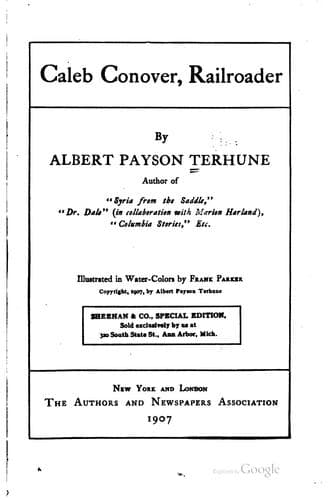
American fiction -- 20th century; Political fiction; Railroad stories; West (U.S.) -- Fiction
“You’ll have to go to Paris for her,” went on Conover, “and bring her
back. Take the next steamer. There’s boats sailing on most of the lines
Wednesdays. Let’s see, this is Monday. Go to Ballston, as you were going
to, to-morrow morning. Get that package from Lanier, and send it to me
from there by registered mail. Be sure to have it registered. Then catch
the afternoon train to New York. That ought to get you in by five-thirty
or six. I’ll telegraph Wendell to-night to find out what’s the fastest
steamer sailing next morning, and tell him to take passage for you. Hunt
him up as soon as you reach town. And sleep on board the boat. That’ll
cut out any chance of your missing it. Bring Blanche back here to us by
the earliest steamer from France or England that you can get. And while
you’re in Paris, if you can hire some one on the quiet to drop over into
Italy and put d’Antri into the accident ward of some dago hospital for a
month or two, I don’t mind paying five thousand for the job. Come up to
my study, and I’ll fix you up financially for the trip, and give you
that note to Bruce Lanier.”
Gerald heard and nodded assent to the rapped-out series of directions
with as little emotion as though commanded to transmit some campaign
message to Billy Shevlin. His father, noting the quiet attention and
response, was pleased therewith. And the latent fondness and trust which
were slowly placing his recent contempt for his only and once adored
son, perceptibly increased.
As the two men left the room, Mrs. Conover looked lovingly after Gerald
through her tears.
“Poor dear boy!” she soliloquized. “He’s getting to be quite his old
bright self again. When Caleb mentioned his going to New York his eyes
lighted up just the way they used to when he was little.”
All unaware that she had detected something which even the Railroader’s
vigilance had overlooked, the good woman once more abandoned herself to
the joys of a new and delightfully unrestrained fit of weeping.
When at last she and her husband were together, alone, that night, Mrs.
Conover had some thought of commenting upon that fleeting expression she
had caught on Gerald’s face. But Caleb was so immersed in his own
unpleasant thoughts she lacked the courage to intrude upon his
reflections.
Which is rather a pity, for had she done so, the inefficient little
woman might have changed the history of the Mountain State.
CHAPTER XIII
THE FOURTH MESSENGER OF JOB
The rain Caleb Conover had so eagerly desired as a check on fair weather
reformers’ Election Day zeal began soon after midnight, and with it a
gale that is still remembered as the “Big November Wind.”
Public-domain text, read in full here on John Shaqi.
Reviews
Reviews
No reviews yet
Be the first to share your thoughts on this work.
Elsewhere in the archive
Join the Discussion
Join the discussion
Sign in to leave a comment or review.
Sign InorCreate an account