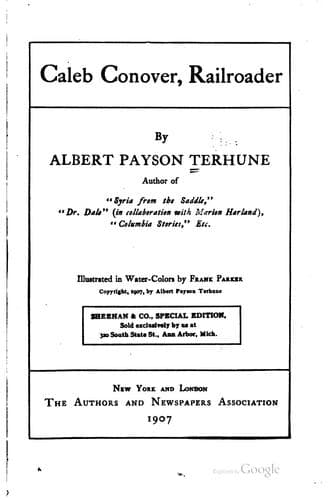
American fiction -- 20th century; Political fiction; Railroad stories; West (U.S.) -- Fiction
The wind-whips lashed the many-windowed Mausoleum, and the roar and
swirl of dashing water echoed from roof and veranda-cover. The autumn
gale-blasts set the naked trees to creaking and groaning like sentient
things. Here and there a huge branch was ripped from its trunk and
ploughed a gash in the lawn’s withered turf. More than one maple and ash
on the Conover grounds crashed to earth with a rending din that was
drowned in the howl of the storm.
A belated equinoctial was sweeping the Mountain State, driven on the
breath of a tornado such as not one year in twenty can record, east of
the Mississippi. Its screaming onset unroofed houses, tore up forest
giants, wrecked telegraph lines, buffeted fragile dwellings to their
fall and dissolved hayricks into miles of flying wisps.
Yet none of the three members of the Conover family, sheltered within
the Mausoleum, were awakened by the bellow of the cyclone, for none were
asleep. Letty, alone in her great, hideous bedroom, lay alternately
praying and weeping in maudlin comfortlessness over her absent daughter;
and at sound of the hubbub outside wept the more and prayed with an
added terror.
Gerald, despite the early start he must make in the morning, was still
dressed, and was slouching back and forth in his suite of apartments,
muttering occasionally to himself, and at other times pausing to gaze
lifelessly ahead of him. As the ever-louder voice of the storm broke in
on his thoughts, he stopped short in his aimless march, his dry lips
twitching and on his face the nervous terror of a suddenly awakened
child. He shambled into an inner chamber, unlocked and opened a drawer
in his chiffonier, fumbled for a moment or two with something he took
therefrom, then closed and locked the drawer and returned to the light.
In a few moments the nervousness had died out of his face and bearing,
and with a return of his habitual listless air he had resumed his walk.
Caleb Conover, stretched on a camp-bed in the corner of his study,
smiled contentedly as the rain beat in torrents on the panes. But when
the gale waxed fiercer and the rain at last ceased, he frowned.
“Going to blow off clear and cold after all!” he grumbled, turning over.
“And the Weather Bureau’s the only one that can’t be ‘fixed.’”
But even the shriek of the storm could not long hold his attention. The
Railroader was vaguely troubled as to himself. Heretofore, like
Napoleon’s, his steel will had been able to dictate to Nature as
imperiously as to his fellow-man. When he had commanded the presence of
Sleep, the drowsy god had hastened on the moment to do his bidding. He
had slumbered or awakened at wish. On the eve of his greatest crisis he
had been unable to sleep like a baby. Yet for the past few weeks he had
been aware of a subtle change. Sleep had deserted him, even as had so
much else that he had loftily regarded as his to command.
Public-domain text, read in full here on John Shaqi.
Reviews
Reviews
No reviews yet
Be the first to share your thoughts on this work.
Elsewhere in the archive
Join the Discussion
Join the discussion
Sign in to leave a comment or review.
Sign InorCreate an account