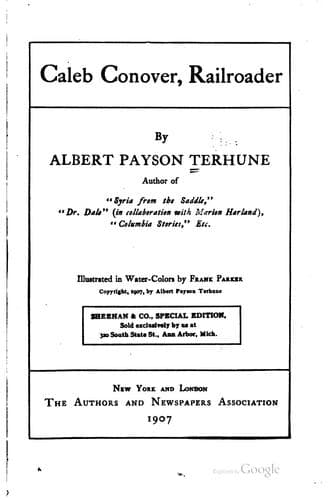
American fiction -- 20th century; Political fiction; Railroad stories; West (U.S.) -- Fiction
He had acquired an unpleasant habit of lying awake for hours in that big
lonely study of his, of seeking in vain to recover his old-time power of
perfect self-mastery. Thought, Memory, Unrest—a trio that never could
unduly assail him in saner hours—now had a way of rushing in upon the
insomniac with the extinguishing of the last light. To-night these
unwelcomed guests were lingering still longer than usual, and all the
Conover’s dominating will power failed to banish them.
At length he gave over the struggle and let his vagrant fancies have
their will. Was he growing old, he wondered, that his forces—mental,
physical and political—thus wavered?
Worry? He had heard others complain of it, and he had laughed at them.
Nerves? Those were for women. Not for a man with an eighteen-inch neck.
Then what ailed him? He had been this way ever since—ever since—Yes, it
was the night Anice Lanier left that he had first lain awake.
Anice Lanier! He had never analyzed his feelings toward her. He had been
dully satisfied to know that in her presence he ever had an unwonted
feeling of content, of sure knowledge that she would understand; that
she was as unlike his general idea of women as he himself differed from
his equally contemptuous estimate of other men; that he was at his best
with her. Had he been less practical and more given to hackneyed phrases
of thought, he would have said she inspired him.
But now? The Railroader could not yet force himself to dwell on the
jarring end of all that. He tried to think of something else. Blanche?
Yes, _there_ was a nice sort of complication, wasn’t it? Another
international marriage and the usual ending thereof.
“These foreigners can give us poor Yankee jays cards and spades at the
bunco game!” he mused, half-admiringly. “They beat _our_ ‘con’ men hands
down, for they don’t even need to pay out cash in manufacturing green
goods and gold bricks, and they don’t get jugged when they’re found out.
When’ll American girls get sense? When their parents do, I presume.”
And this unwelcome answer to his own question brought him back to the
memory of his joy at hearing of Blanche’s proposed marriage to d’Antri.
It had seemed to him to set the capstone of fulfilment to his social
yearnings. As father of a princess, he had in fancy seen himself at last
exalted amid the close-serried ranks of that class to whom only his
wealth had heretofore entitled him to ingress. And money—even _his_
money—had failed to act as _open sesame_. But surely as father-in-law to
a prince——
Even the very patent fiasco attendant on his one effort to use this
relationship as a master key to the portals of society had not wholly
discouraged him. Later, when, practically by acclamation, he should have
won the Governorship, and when the Princess d’Antri’s European triumphs
should be noised abroad in Granite, surely _then_——
Public-domain text, read in full here on John Shaqi.
Reviews
Reviews
No reviews yet
Be the first to share your thoughts on this work.
Elsewhere in the archive
Join the Discussion
Join the discussion
Sign in to leave a comment or review.
Sign InorCreate an account