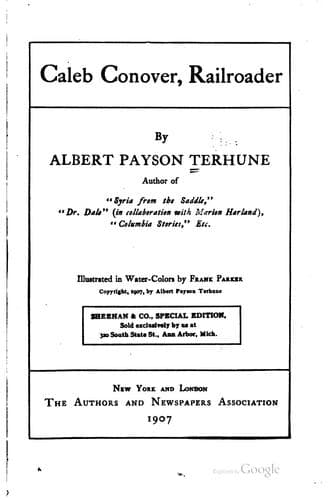
American fiction -- 20th century; Political fiction; Railroad stories; West (U.S.) -- Fiction
“Your son reached town a little after six o’clock this evening,”
answered Wendell. “It seems he went directly to a restaurant in the
theatre district of Broadway, a place frequented by men of a certain
class and by the women they take there. It was early, but on account of
the election night fun to come later many people were already dining.
Gerald afterward told me he went there in the hope of catching a glimpse
of his former wife. He saw her there. With her was a man she had known
before she met your son, a bookmaker named Stange, whom Gerald—or
Gerald’s money—had originally won her from, and for whom he always, it
appears, retained some jealousy. Gerald walked straight up to the table
where they sat, drew a revolver and fired four times point-blank in
Stange’s face. Any one of the shots by itself would have been fatal.
Then he tossed the revolver to a waiter and spent the time until the
police arrived in trying to console this Montmorency woman and to quiet
her hysterics. They took him to the Tenderloin station and he got the
police to telephone for me. I found him in a state of semi-collapse. A
police surgeon was working over him. Heart failure brought on by
excitement. His heart was already in a depressed, weakened state, the
surgeon said, from an overdose of morphine. The poor boy apparently was
in the habit of taking it, for they found a case with a hypodermic
syringe and tablets in his pocket. And one of his arms——”
“So that was the ‘third thing’ beside booze and cigarettes?”
It was Caleb’s first interruption. During the recital of his son’s crime
he had stood motionless, expressionless. Not until this trivial detail
was reached had he spoken. And even now his voice was as emotionless as
was his face. The inscrutable Spartan quiet that had so often left his
business and political opponents in the dark was now upon him. Wendell
saw and wondered. Mistaking the other’s mental attitude for the first
daze of horror, he resumed:
“He came around in a few minutes. I did what I could for him. Then I
tried to reach you by long-distance telephone. But the wires were down
all through this State. I had no better fortune in telegraphing. So I
caught the eight-ten train and came straight here. I thought you ought
to be told at once, so that——”
“Quite so. Thank you. It was very white. I’m sorry I was so brisk with
you awhile ago.”
The lawyer stared. Conover was talking as though a mere financial matter
were involved. Still supposing his client suffering from shock that
dulled his sensibilities, Wendell continued:
“Morphine and jealousy combining to cause temporary insanity. That must
be our line of defence. You agree with me of course?”
“Suit yourself. I’ll stand by whatever you suggest.”
The lawyer drew out his watch.
“Twelve forty-five,” he said. “The New York express passes through
Granite at one twenty. We’ll have plenty of time to catch it. If you
will get ready at once, we’ll start. We can discuss details during the
trip.”
Public-domain text, read in full here on John Shaqi.
Reviews
Reviews
No reviews yet
Be the first to share your thoughts on this work.
Elsewhere in the archive
Join the Discussion
Join the discussion
Sign in to leave a comment or review.
Sign InorCreate an account