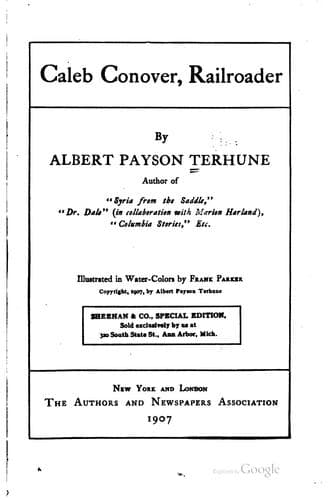
American fiction -- 20th century; Political fiction; Railroad stories; West (U.S.) -- Fiction
He paused. There seemed nothing more to say, yet he longed to end with a
climax. A glorious, dazzling inspiration came, and he hurried on:
“And now, in honor of this little meeting between friends, let me tell
you all a secret. It won’t be a secret to-morrow, but you can always be
able to say you were the first who was told. I have at last yielded to
the earnest entreaties of my constituents and friends and party in
general, and have consented to accept the nomination for Governor at the
coming convention.”
From the proletariat fringing the walls and blocking the doorway arose
an excited, exultant hum. Only the wild efforts of certain efficient, if
unofficial, sergeants-at-arms prevented a mighty yell of applause. At
the tables, however, the women looked bored or puzzled; while the men
glanced at each other with the blank look of people who, out for a day’s
jolly hunting, find themselves caught unexpectedly in a bear trap.
“Good Lord!” grunted Greer, “I hope our being here doesn’t commit any of
us! To think of Conover, of all men, as governor! This’ll be a bombshell
with a vengeance.”
“I have heretofore,” went on Caleb, after allowing the impression of his
words to sink in, “refused all State offices. But now I feel it a social
as well as a political duty that I owe. And I shall be grateful to you
for your honest support.”
He had rehearsed this last sentence many times for campaign speeches. It
seemed to him to have the true oratorical ring, and to be singularly
appropriate. He prepared to sit down, then checked himself.
“Some men,” he added, as an afterthought, “are in politics for a ‘holy’
purpose. Some for what’s in it for them. I find the result’s usually
pretty much the same in both cases. As governor I shall do my best for
Granite and for the Mountain State. Thank you.”
Caleb bowed, reseated himself and swallowed another glass of champagne
at a gulp. He was not ill pleased with himself. He had risen merely to
thank his guests for their presence. Little by little he had drifted
further than he had at first intended. Yet, he was glad he had yielded
to this unprecedented, unaccustomed yearning to expand; to show himself
at his best before these people with whom he now firmly believed himself
on a footing of friendly equality. Yes, on the whole, he was convinced
of his success.
He glanced about him. The buzz of talk had recommenced; it seemed to him
more loudly, more interestedly, with less of constraint than before.
Dozens of eyes were upon him, not with the bored coldness of the earlier
evening, but with curiosity and open interest. He had put people at
their ease. They were accepting him as one of themselves, and behaving
as he had heard they did at other functions.
Caleb was glad.
Then his complacent glance fell on his wife. She was very red in the
face, and was bending over her plate, eating fast.
Public-domain text, read in full here on John Shaqi.
Reviews
Reviews
No reviews yet
Be the first to share your thoughts on this work.
Join the Discussion
Join the discussion
Sign in to leave a comment or review.
Sign InorCreate an account