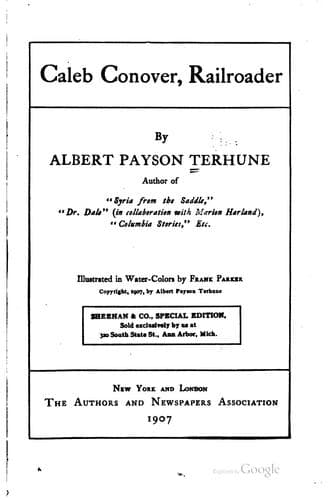
American fiction -- 20th century; Political fiction; Railroad stories; West (U.S.) -- Fiction
It was the morning after his “début.” He paced his study intermittently,
stopping now and again at a window to watch laborers at work in the
grounds below, dismantling the strings of Chinese lanterns, and carting
away other litter of the festivities. A pile of newspapers filled one of
the study chairs. On the front page of each local journal was blazoned a
garish account of the Conover reception. Yet Caleb, eager as he had once
been to read every word concerning the fête, had not so much as glanced
at any of the papers. In fact, he seemed, in his weary pacing to and
fro, to avoid the locality of the chair where they lay.
For an hour—in fact, ever since he had left his bedroom—he had paced
thus. And none had dared disturb him. For the evil spirit was heavy upon
Saul, and the javelin of wrath, at such times, was not prone to tarry in
its flight.
Caleb’s black mood this morning came from within, not from objective
causes. He was travelling through that deepest, most horrible of all the
multi-graded Valleys of Humiliation—the Vale of Remembered Folly. Let a
man recall a crime, and—especially if he be troubled at the time with
indigestion—remorse of a smug if painful sort will be his portion. Let
him recall a misfortune, and a wave of gentle, self-pitying grief will
lave his heart, soothing the throb of an old sting into soft regret. But
let him awake to the fact that he has made himself sublimely
ridiculous—and that in the presence of the multitude—and his
self-torture can be lashed to a pitch that shames the Inquisition’s most
zealous efforts. Therein lies the True Valley of Humiliation, the ravine
where no sunlight of redeeming circumstances shines, where no refreshing
rill of excuse and palliation flows. And it was in this unrelieved, arid
gorge of self-contempt that Caleb Conover now wallowed.
He had made a fool of himself. An arrant fool. He had drunk until he was
drunken. And in that drunkenness he had spoken blatant words of idiocy.
He had made himself ridiculous in the eyes of the very class he had
sought to cultivate. His had not been the besottedness that babbles,
sleeps and forgets. Even as his drink-inspired tongue had betrayed no
thickness nor hiatus during his drivelling speech, so the steady brain
had, on waking, remorselessly told him of his every word.
Thirty years before, in a drunken spree, he had been seized with a
fervor of patriotism and had enlisted in the army. On coming to himself
it had cost him nearly every dollar he possessed to get himself free.
After a similar revel, a year later, he had stampeded a meeting of the
local “machine” by making a tearful speech in favor of reform and purity
in politics. The oration had cost him his immediate chances of political
preferment. After that he had done away with this single weakness in his
iron nature and had drunk no more. The sacrifice had been light for so
strong a man, once he forced himself to make it.
Public-domain text, read in full here on John Shaqi.
Reviews
Reviews
No reviews yet
Be the first to share your thoughts on this work.
Join the Discussion
Join the discussion
Sign in to leave a comment or review.
Sign InorCreate an account