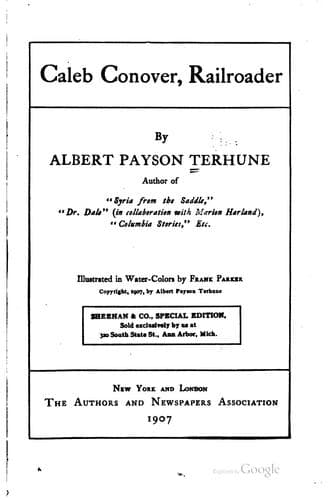
American fiction -- 20th century; Political fiction; Railroad stories; West (U.S.) -- Fiction
“You’re a noble work of God, Miss Lanier, ain’t you?” he sneered. “In
Bible days the man who betrayed his Master was made the star villain for
all time. But when it’s a woman that does the betraying, I guess even
the Bible would have to go shy on words blazing enough to show her up.
For three years,” he went on, as Anice, by a quick gesture, silenced
Clive’s fierce interruption—“for three years and more you’ve eaten my
bread and lived on my money. For three years I’ve treated you like you
were a queen. Whatever I’ve done or been to other folks, to _you_ I’ve
been as white as any man could be. You’ve had everything from me and
mine. And you pay me by playing the petticoat-Judas. Look here, there’s
something behind all this! Tell me what it means.”
“It means,” answered Anice, who had borne without wincing the hot lash
of the angry man’s scorn—“it means that I have tried to pay a debt. Part
I have paid. Part I am paying.”
“A debt? What rot are you trying to talk? I——”
“If you care to listen I’ll tell you. I will make it as short as I can.
Shall I go on?”
Conover nodded assent as a man in a dream.
“My father,” began Anice, speaking dispassionately, her rich voice
flattened to a quiet monotone—“my father was Foster Lanier. You never
knew him. You never knew many of the men you have wrecked. But he was
chief stockholder in the Oakland-Rodney Railroad. He was not a business
man. The stock was left him by his father. It was all we had to live on.
It was enough. You owned the C. G. & X. Little by little you bought up
the other Mountain State roads. At last you came to the Oakland-Rodney.
Do you remember?”
“I remember my lawyer told me there was some stiff-necked old fossil who
owned the majority stock and wouldn’t sell.”
“So you crushed him,” went on Anice, unmoved, “as you have crushed
others. You cut off the road’s connecting points and severed its
communication with your own and your allied lines. After isolating it
you lowered your own freight rates and mileage until all the
Oakland-Rodney patronage was gone. The road collapsed, and you bought it
in. My father was a pauper. Other men have been driven to the same
straits by you—men whose very names you did not take the trouble to
learn. My father knew little of business. To save others who had bought
Oakland-Rodney stock at his advice, he sold what little property he had
and bought their worthless stock back at par. He was ruined and above
his head in debt. My mother was an invalid. The doctors said a trip to
the Mediterranean might save her life. We had not a dollar. So she died.
My father—he was out of his mind from grief and from financial worry—my
father shot himself. It was hushed up by our friends, and he was
reported accidentally killed while hunting. It was only one of the
countless victories you ‘financiers’ are so proud of. He and my mother
were but two of the numberless victims each of those victories entails.”
Public-domain text, read in full here on John Shaqi.
Reviews
Reviews
No reviews yet
Be the first to share your thoughts on this work.
Elsewhere in the archive
Join the Discussion
Join the discussion
Sign in to leave a comment or review.
Sign InorCreate an account