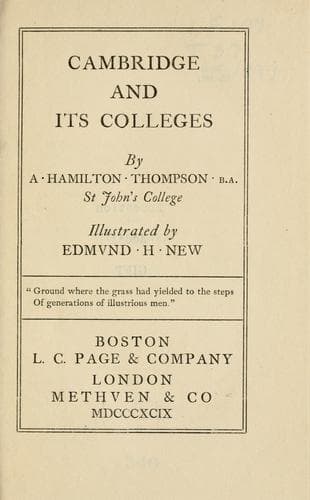
Cambridge and Its CollegesThompson, A. Hamilton (Alexander Hamilton)
History
Cambridge and Its Colleges
Thompson, A. Hamilton (Alexander Hamilton)
University of Cambridge
Beyond the Hall, Nevile built the court, which bears his name, and, for
a certain beauty of its own, is not far behind the Great Court. Ralph
Symons was again his architect. This building consisted of two wings,
shorter than at present, at right angles to the Hall, and built above a
cloister. These splendid arcades are the very crown of Renaissance work
in Cambridge; their cloistered ground-floor recalls Bologna or Padua
rather than the court of an English university; but their upper stories
are thoroughly English work. Nevile’s Court did not assume its present
secluded, aristocratic appearance until considerably more than a hundred
years later. Isaac Barrow, one of the many great Masters of Trinity,
began the library in 1675, with Sir Christopher Wren as his architect.
The court was completed by the generous addition of two compartments to
the original arcades, which was paid for by some of the fellows. Wren’s
Library is so prominent that its incongruity with the rest of the court
is not at once obvious, but there can be no doubt that it is seen at its
best on the river side. Its front towards the court is adorned with a
bas-relief which represents the dedication of the Septuagint to Ptolemy
Philadelphus. On the roof are four statues of learned nymphs by Gabriel
Cibber, which are chiefly remarkable for the part they played in one of
Byron’s most senseless freaks. The interior of the Library is matchless
for its magnificent simplicity. It is a pity that the arbiters of taste
in the last century should have allowed Cipriani to design the window
at the south end, but this is the sole fault. The numerous busts (some
by Roubiliac), the carvings on the bookcases (Grinling Gibbons) and
Thorwaldsen’s statue of Byron are remarkable.
Wren is also supposed to have harmonised the side of the Hall which
stands opposite, with his Library. The present meaningless alcoves and
the balustrade which have superseded Nevile’s work on this side, are
probably by Essex, who was brought in to prop up the Hall and build the
Combination Room and Kitchen Offices in 1771. A little while before Wren
began working at Trinity, John Hacket, Bishop of Lichfield and Coventry,
founded Bishop’s Hostel, the small building south of the Great Court,
and close to the Trinity Lane entrance. These buildings (1670) are now
somewhat overlapped by the modern buildings of Garret Hostel, which are
also of red brick. Garret Hostel is, however, a much older component of
Trinity, and the modern buildings are simply a revival.
Public-domain text, read in full here on John Shaqi.
Reviews
Reviews
No reviews yet
Be the first to share your thoughts on this work.
Elsewhere in the archive
Join the Discussion
Join the discussion
Sign in to leave a comment or review.
Sign InorCreate an account