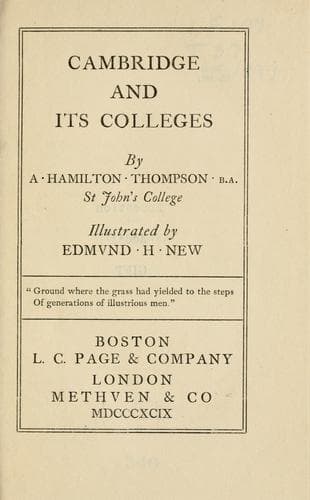
Cambridge and Its CollegesThompson, A. Hamilton (Alexander Hamilton)
History
Cambridge and Its Colleges
Thompson, A. Hamilton (Alexander Hamilton)
University of Cambridge
These various buildings and others which had grown about them were
gathered together in the reign of James I., and the result is the Great
Court, one of the largest and certainly without exception the most
beautiful of quadrangles in the world. Trinity owes a great debt to
Thomas Nevile, who was master from 1593 to 1615. To bring his buildings
into a systematic form, he took down King Edward III.’s tower and rebuilt
it west of the chapel. He added the upper storey to the great gateway,
and placed the statue of Henry VIII. in a niche outside, while on the
side towards the court he set up in corresponding niches statues of James
I., Prince Charles, and the Princess Elizabeth. On the south side he
built the Queen’s tower, which contains the figure of Queen Mary, and
is exactly opposite King Edward’s tower. Finally, to the west he built
the Hall, north of the old hall of Michael House, and, further north
still, the Master’s Lodge. His architect was that admirable genius, Ralph
Symons. Although the Great Court has been partly faced with stucco and,
in certain places, refronted, its beauty is indestructible. The sets of
rooms which join the towers and other buildings together, have their
height in very just proportion to the size of the quadrangle. What the
effect would be, were they higher than they are, may be seen by comparing
the Jacobean buildings with Essex’s classical addition near the kitchen,
and the modern Gothic buildings between the Chapel and Lodge. The beauty
of the court finds its central point, perhaps, in Nevile’s exquisite
fountain, built in 1602, which has all the best attributes of English
Renaissance work. It may be compared with the gateway just outside the
south-western corner of the court.
The Hall, with its light oriels and graceful louvre, was finished in
1604. Its interior is, perhaps, a little over-decorated, but possesses
a certain splendour which finds no parallel in England. The western
gallery, covered with rich carving and highly gilded, may be compared
with the similar galleries at Audley End and other contemporary houses.
The portraits are interesting, although of no great excellence as
a whole. Newton, Bacon, and Barrow occupy the north end, and other
celebrities, such as Dryden, Cowley and Pearson, are to be found on the
side walls above the panelling. Sir Joshua Reynolds’ charming portrait
of the little Duke of Gloucester hangs close to the western oriel, and
near it is Mr Watts’ portrait of Tennyson. Other modern portraits are
those of Thackeray (Lockhart Bogle), Dr Thompson (Herkomer), Dr Lightfoot
(Richmond), and, of living celebrities, Professor Michael Foster
(Herkomer) and Dr Henry Jackson (C. W. Furse).
[Illustration: The Fountain
Trinity College
E·H·N]
Public-domain text, read in full here on John Shaqi.
Reviews
Reviews
No reviews yet
Be the first to share your thoughts on this work.
Elsewhere in the archive
Join the Discussion
Join the discussion
Sign in to leave a comment or review.
Sign InorCreate an account