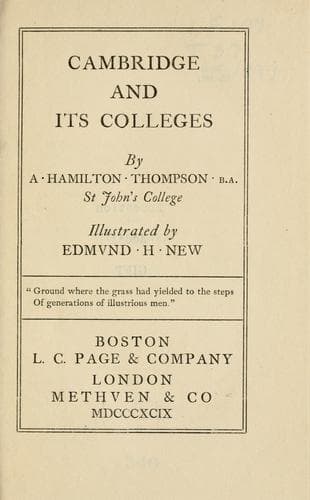
Cambridge and Its CollegesThompson, A. Hamilton (Alexander Hamilton)
History
Cambridge and Its Colleges
Thompson, A. Hamilton (Alexander Hamilton)
University of Cambridge
The royal foundation of Trinity College is, as a matter of fact, one of
the youngest colleges in Cambridge. At the same time, it is to Cambridge
what Christ Church is to Oxford, and, more than that, its name, to a
great number of people, is almost synonymous with Cambridge. Henry VIII.,
the most learned of our English sovereigns, was naturally a great patron
of learning. In 1546, the year in which, with his characteristic want
of scruple, he took upon himself the credit of founding Wolsey’s great
college at Oxford, he also founded Trinity at Cambridge. His material was
ready to hand, for the small colleges and hostels which filled up the
space between the present Trinity Street and the river provided scanty
room for their members, and needed amalgamation. Trinity, in fact, as
it now exists, is composed of a number of separate foundations, the
principal of which were Michael House, founded in 1324, and King’s Hall,
founded by Edward III. in 1337. These two colleges had gradually absorbed
many of the smaller hostels. The founder of Michael House was Hervé de
Staunton, treasurer to King Edward II. In spite of its limited situation,
it had a certain amount of prestige, and one of its last masters was John
Fisher, afterwards President of Queens’ and Bishop of Rochester. It
used the church of St Michael as its chapel. King’s Hall, on the other
hand, had, by the time of Henry VIII., extended its boundaries and built
its own chapel. It had grown out of a corporation of scholars, which had
found a patron in Edward II., and had been presented by Edward III., in
1336, with a piece of ground belonging to one Robert of Crowland—which
may point to a connection between the foundation and Crowland Abbey, the
great centre of English learning. A regular charter was granted in 1337.
The accounts of the institution remain, and point to a style of living
which would not be very highly accounted of now, but was positively
luxurious for medieval Cambridge. The scholars attended chapel at St
Mary’s by the Market and All Saints’ in the Jewry, until, in Edward IV.’s
reign, they obtained leave to found a chapel for themselves. King’s Hall
naturally became the nucleus of Henry’s college, and the lesser buildings
found their centre in its court, enlarged and beautified. John Redman,
the last master of King’s Hall, became the first master of Trinity
College.
Public-domain text, read in full here on John Shaqi.
Reviews
Reviews
No reviews yet
Be the first to share your thoughts on this work.
Elsewhere in the archive
Join the Discussion
Join the discussion
Sign in to leave a comment or review.
Sign InorCreate an account