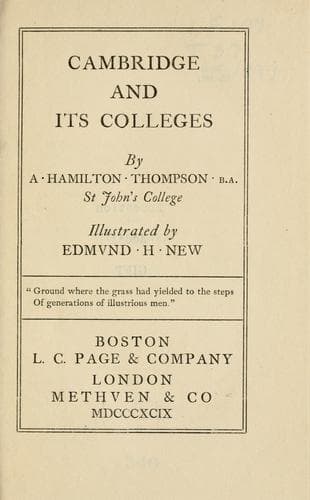
Cambridge and Its CollegesThompson, A. Hamilton (Alexander Hamilton)
History
Cambridge and Its Colleges
Thompson, A. Hamilton (Alexander Hamilton)
University of Cambridge
Under the charter of 1546, Henry VIII. founded Trinity College for a
master and sixty fellows and scholars. The full title was “Trinity
College within the Town and University of Cambridge of King Henry the
Eighth’s foundation.” Michael House, dedicated primarily to St Michael
the Archangel, had been founded under the secondary invocations of the
Holy and Undivided Trinity, St Mary, and All Saints; and it is probable
that the first of these suggested the name under which the college
has become so famous. Trinity College is the most distinguished fruit
of that revived learning which paved the way for and accompanied the
Reformation: from the very beginning its tendencies were liberal and
progressive; every genius which it nourished was eminently constructive.
The names of its three greatest _alumni_, Newton, Bacon, and Barrow,
form, so to speak, the three fountain-heads of organized philosophical
thought in England; and there are a hundred less monumental names which
are sufficient guarantee of the intellectual supremacy of Trinity over
her sisters. The history of the college divides itself naturally into
periods. The first is a period of consolidation, extending from 1546 to
1593. During this time, the college suffered the ordinary vicissitudes
of the Reformation. Its chapel, which had been projected by Henry
VIII., was begun by Mary and finished, probably out of a sense of duty,
by Elizabeth. In 1553, William Bill, the second master, who had been
appointed under Edward VI., had to retire in favour of a Catholic master,
John Christopherson, but was of course restored at the accession of
Elizabeth. He was succeeded in 1561 by Robert Beaumont, who presented to
the Master’s Lodge a portrait of the founder by Lucas van Heere, one of
the most excellent portrait-painters of the sixteenth century. Beaumont,
in his turn, was succeeded by John Whitgift, who was already well known
in Cambridge as Master of Peterhouse and Pembroke, and Fellow of Queens’.
Whitgift, with Matthew Parker and Matthew Hutton, is one of the three
divines who may be taken as typical of Elizabethan Cambridge—strongly
anti-papal in their sentiments, but keeping nevertheless a cautious eye
on the political balance. It is hardly necessary to add that Whitgift’s
long list of Cambridge preferments eventually led to the Archbishoprick
of Canterbury. And it was during his mastership that the greatest
intellect of the age was trained at his college. Under the yoke of
the Aristotelian system of philosophy, Francis Bacon, while still at
Cambridge, perceived the fallacies of the stereotyped methods of thought,
and laid the foundation of inductive science. Bacon’s life is connected
more intimately with affairs of state than with his University; but
Trinity regards him as one of the principal saints in her kalendar, and
his memory greets the visitor at every turn. His portrait is one of the
three at the end of the Hall; there is another in the Master’s Lodge;
Public-domain text, read in full here on John Shaqi.
Reviews
Reviews
No reviews yet
Be the first to share your thoughts on this work.
Elsewhere in the archive
Join the Discussion
Join the discussion
Sign in to leave a comment or review.
Sign InorCreate an account