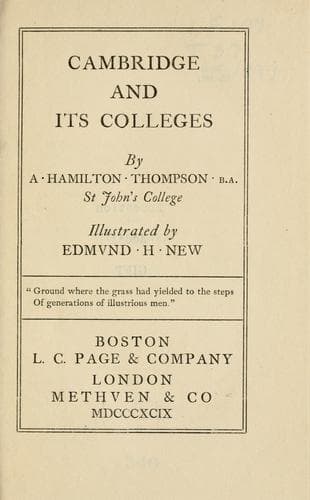
Cambridge and Its CollegesThompson, A. Hamilton (Alexander Hamilton)
History
Cambridge and Its Colleges
Thompson, A. Hamilton (Alexander Hamilton)
University of Cambridge
his bust, by Roubiliac, is in the Library; and, in 1845, his statue was
placed, side by side with that of Newton, in the antechapel.
Bacon is the great figure of this early period. Nine years older than
he, the Lord Chief Justice Coke (* Whood: bust by Roubiliac) is the
first of the great lawyers connected with Trinity. Another celebrated
name is that of Dr Donne, Dean of St Paul’s, divine and poet. Sir Henry
Spelman (* Whood), the antiquary and translator of Xenophon, was a
contemporary of Bacon, and, some years after, Sir Robert Cotton (* bust
by Roubiliac) furnished Trinity with another archæologist. Whitgift,
after his translation to Canterbury, was succeeded by John Still, who
became Bishop of Bath and Wells. With Still’s successor, Dr Thomas
Nevile,* master from 1593 to 1615, the second period opens. Nevile held
the Deanery of Canterbury with his mastership, but his life was spent in
Cambridge, and his architectural work in Trinity, while it is the most
important in the University, stamps him as the chief benefactor of the
college. In that great age of building, Nevile’s work has an honourable
pre-eminence: it is the sign of a monumental perseverance and an artistic
taste which, even in that fine era of Renaissance culture, was never
surpassed. We may with justice echo the words of Fuller, who says that
Dr Nevile performed this work “answering his anagram _most heavenly_,
and practising his own allusive motto _ne vile velis_.” Higher praise
could not be given. Nevile’s buildings, if architecture may be considered
to reflect contemporary history, may be regarded as a turning-point in
Cambridge thought. When we look at the reactionary tendency to the Gothic
taste in Jacobean Oxford, and compare it with the distinct preference
shown in Cambridge for classical and Renaissance models, the radical
divergence of the two Universities is clear. Nevile’s courts at Trinity
were the beginning of a long series of collegiate buildings which, often
very defective, took the place of Gothic work and held it for the next
two centuries. The sole exception to this rule is Matthew Wren’s chapel
at Peterhouse. Besides his building energy, Nevile acquired land for the
college, so that, when the Society enlarged its buildings in after years,
it found itself in possession of the requisite site. The King’s Court
occupies part of this property. One can only say that Nevile’s memory
might be honoured with a better building.
Public-domain text, read in full here on John Shaqi.
Reviews
Reviews
No reviews yet
Be the first to share your thoughts on this work.
Elsewhere in the archive
Join the Discussion
Join the discussion
Sign in to leave a comment or review.
Sign InorCreate an account