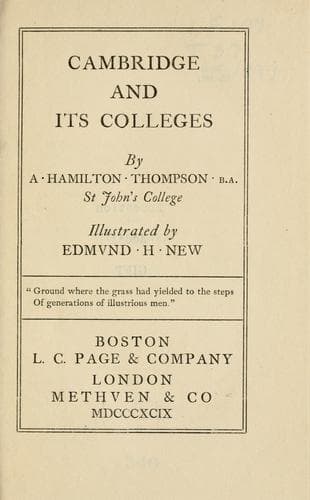
Cambridge and Its CollegesThompson, A. Hamilton (Alexander Hamilton)
History
Cambridge and Its Colleges
Thompson, A. Hamilton (Alexander Hamilton)
University of Cambridge
The seventeenth century is fertile in great men. During the century,
however, none of the masters of the college were very conspicuous men,
and the mastership, between 1615 and 1683, changed hands no less than
twelve times. It is also worthy of remark that three successive masters
ended their lives as Bishops of Chester, thus uniting Henry VIII.’s
collegiate foundation with one of his bishopricks. These were John
Wilkins (* Whood), master in 1659, Henry Ferne, master in 1660, and
John Pearson (* Whood), master from 1662 to 1673. This last is the only
exception to the general insignificance of the masters at this time. He
was a distinguished scholar who had been connected with several colleges,
and had held the mastership of Jesus. His work on the Apostles’ Creed
is still one of the classics of English theology. About the middle of
the century, Dryden (* Hudson) came to Trinity from Westminster School.
Both he and Abraham Cowley (* Slaughton) were strongly attached to the
Royalist side during the Commonwealth disturbances, and Cowley, who
entered the college in 1637 and proceeded to his master’s degree, was
expelled in 1643 on account of his too strongly expressed loyalty. He
found more congenial soil at St John’s College, Oxford, the college of
Laud, Juxon, and others of the same party. If to these poets we add the
names of the naturalists Ray (* Hudson: bust by Roubiliac) and Willoughby
(bust by Roubiliac) we shall have enumerated the most illustrious Trinity
men of their time. Ray and Willoughby, who studied natural history with
special reference to its religious character, were, in fact, the founders
of the modern science, just as Dryden may be said to have struck the
first note of modern poetry.
Public-domain text, read in full here on John Shaqi.
Reviews
Reviews
No reviews yet
Be the first to share your thoughts on this work.
Elsewhere in the archive
Join the Discussion
Join the discussion
Sign in to leave a comment or review.
Sign InorCreate an account