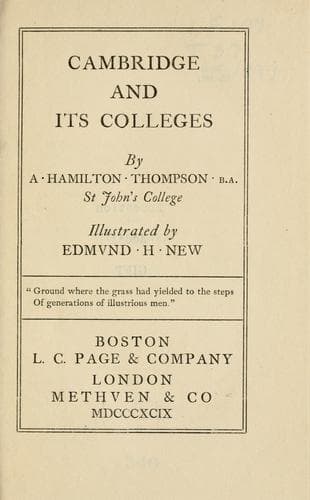
Cambridge and Its CollegesThompson, A. Hamilton (Alexander Hamilton)
History
Cambridge and Its Colleges
Thompson, A. Hamilton (Alexander Hamilton)
University of Cambridge
Pearson became Bishop of Chester in 1672, and removed there in 1673.
Under his successor, Isaac Barrow, began the golden age of Trinity.
Barrow is, in many ways, the most extraordinary genius of whom Cambridge
can boast. He was one of that rare class whose knowledge is practically
universal. He was born in 1630, a year before his great contemporary,
John Locke, who went up to Oxford from Westminster about the time when
Barrow went up from Charterhouse to Cambridge. Barrow was a man of
surprising energy and, at Cambridge, he appears to have read deeply in
every subject which was then studied. He was classic, mathematician,
scientist, theologian, and orator; and in each of these branches he
excelled. He was appointed Regius Professor of Greek in 1655, and,
subsequently, Lucasian Professor of Mathematics—a feat which, to the
scholars of to-day, would seem next to impossible. Undoubtedly, however,
his promotion to the mastership of his college and his subsequent
celebrity were due to his fame as a divine. His sermons bear the same
relation to his age that those of Jeremy Taylor bear to the Stewart
period. He was in high favour as a preacher at court, and, on Pearson’s
retirement, his appointment was obvious. He did not hold the mastership
for more than four years, as in 1677 he died at the age of forty-seven.
His portrait by Hudson hangs in the college Hall; his bust, by Roubiliac,
is in the Library; and his statue, by Noble, was placed in the antechapel
during the mastership of his worthy successor, Whewell.
Public-domain text, read in full here on John Shaqi.
Reviews
Reviews
No reviews yet
Be the first to share your thoughts on this work.
Elsewhere in the archive
Join the Discussion
Join the discussion
Sign in to leave a comment or review.
Sign InorCreate an account