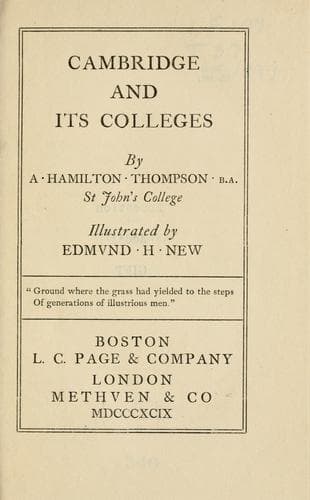
Cambridge and Its CollegesThompson, A. Hamilton (Alexander Hamilton)
History
Cambridge and Its Colleges
Thompson, A. Hamilton (Alexander Hamilton)
University of Cambridge
With Thackeray we are hard on the heels of our own age. The modern
period of Trinity’s history begins with the mastership of William
Whewell, whose name is inseparable from his college. The twenty-five
years of his mastership, from 1841 to 1866, form a very distinguished
epoch. As scholar, organiser, and benefactor to the foundation, he was
pre-eminent. The famous epigram which said of him that “Science was his
forte and omniscience his foible” was in the main true, but he carried
to everything he attempted an immense interest and a sound judgment.
His statue very worthily completes the group in the antechapel. It
was erected during the mastership of his successor, William Hepworth
Thompson (* Herkomer) the Platonist, famous for his erudition and his
_bons mots_. Before his elevation to the mastership, Dr Thompson had been
Regius Professor of Greek. The men of his generation who belonged to the
Society were men of the highest eminence; the best known are, perhaps,
Joseph Barber Lightfoot (* Richmond, Dickinson), the commentator on St
Paul’s Epistles and Bishop of Durham; James Clerk Maxwell,* Professor
of Experimental Physics in the University; the late Arthur Cayley (*
Dickinson), the greatest mathematician whom Trinity boasts since the
days of Newton; and the Public Orator, W. G. Clark (bust by Woolner),
Thompson’s life-long friend. When Thompson died in 1886, he was succeeded
by the present master, Dr Butler, who had been Head Master of Harrow and
Dean of Gloucester. Beneath these rulers, and with the highest prestige
in the world as her tradition, Trinity fully justifies her distinction
as a royal foundation and a nursing-mother of sound and religious
learning. To select from the present society is invidious; but the names
of Professor Henry Sidgwick, Professor Michael Foster (* Herkomer), Dr
Henry Jackson (* Furse), and Professor Jebb, are of European repute,
to say nothing of the present vice-master, Mr Aldis Wright, editor of
Shakspeare, and Mr John Willis Clark, the present Registrary, whose
investigations in Cambridge history and antiquities are well known
everywhere. In the Church one may point to the theologian Dr Westcott,
Bishop of Durham, to Dr Farrar, Dean of Canterbury, and to the late
Charles Alan Smythies, Bishop of Zanzibar; among politicians, to Mr
Arthur and Mr Gerald Balfour, and Sir William Harcourt; while of doctors,
lawyers and men of letters the crowd cannot be numbered.
XVII
EMMANUEL COLLEGE
Public-domain text, read in full here on John Shaqi.
Reviews
Reviews
No reviews yet
Be the first to share your thoughts on this work.
Elsewhere in the archive
Join the Discussion
Join the discussion
Sign in to leave a comment or review.
Sign InorCreate an account