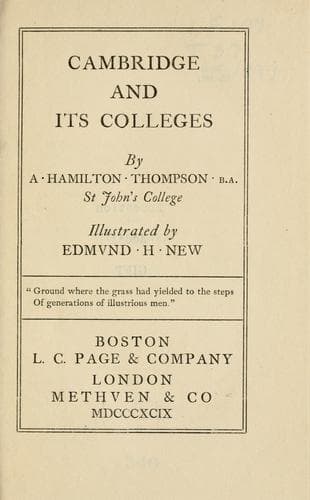
Cambridge and Its CollegesThompson, A. Hamilton (Alexander Hamilton)
History
Cambridge and Its Colleges
Thompson, A. Hamilton (Alexander Hamilton)
University of Cambridge
During Wordsworth’s time, the college was full of great men. Adam
Sedgwick* was Professor of Geology. Another member of the college was
Thomas Babington Macaulay, who was born with the century. As Fellow of
Trinity, the great historian was thoroughly identified with the college,
and, nine years after his death, his statue, by Woolner, was placed among
the distinguished society of the antechapel. Younger by nine years than
Macaulay was Alfred Tennyson (* Watts), who, in a few exquisite verses,
made himself peculiarly the poet of Trinity. The chief event of his
Cambridge life was, of course, his friendship for Arthur Henry Hallam,
who lived, as is well known, in the New Court. Tennyson himself was
otherwise not greatly attached to Cambridge. He lived at some distance
from Trinity, in Corpus Buildings, and went down without taking his
degree. In this respect, Thackeray (* Bogle), two years his junior, was
very different from him. Through all his life, Thackeray, although he was
so closely identified with London, kept his love for Cambridge, and was
at heart a don. While still in residence, he would walk reading along
one of the paths in the Great Court, and, in after life, he constantly
returned. His rooms were close to Newton’s, north of the Great Gate.
Probably no one has handled University life with more success—the subject
is proverbially difficult—than Thackeray in the early chapters of
_Pendennis_; and, in most of his novels, he sent his heroes to colleges
which, whether he placed them in Oxford or Cambridge, have all the
features of his beloved Trinity.
Public-domain text, read in full here on John Shaqi.
Reviews
Reviews
No reviews yet
Be the first to share your thoughts on this work.
Elsewhere in the archive
Join the Discussion
Join the discussion
Sign in to leave a comment or review.
Sign InorCreate an account