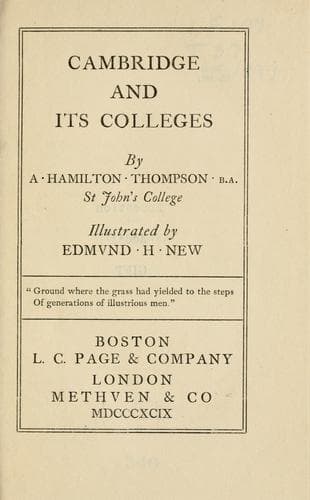
Cambridge and Its CollegesThompson, A. Hamilton (Alexander Hamilton)
History
Cambridge and Its Colleges
Thompson, A. Hamilton (Alexander Hamilton)
University of Cambridge
After the time of Law and the non-jurors, the history of Emmanuel is
very quiet, and the stately ease for which its buildings are conspicuous
possessed the college. During the mastership of Dr William Richardson,*
in 1765, a member of the college published a book which had a tremendous
effect on English literature. This was the _Reliques of Ancient English
Poetry_, collected by Bishop Percy of Dromore. The labours of this
antiquarian are a lasting glory to his college. A similar taste was
apparent in Richardson’s successor, “rare” Richard Farmer (* Romney) who
was master from 1775 to 1797. The love of himself and his _coterie_ for
Shakspeare took him, night after night, to the theatre at Stourbridge
Fair, and his affection for the drama combined with his good-fellowship
made him something of a curiosity at the time when most college masters
were dry and pedantic. To the same period belongs Samuel Parr, whose
pipe, tobacco-box, and stopper are preserved by the College. He was
undoubtedly a wit and a good talker, but his jokes were lengthy and
pompous, and he scarcely deserves the praise of those admirers who have
likened him to Dr Johnson and Sydney Smith. For most of us, possibly, he
lives entirely by virtue of de Quincey’s essay upon him.
The two most famous scholars whom Emmanuel produced in the eighteenth
century were Joshua Barnes,* Professor of Greek at its beginning, and
Richard Hurd,* Bishop in succession of Lichfield and Worcester, who
died in 1808. Hurd was a theologian with a somewhat dull pen, and is
now chiefly remembered as the disciple, friend and biographer of Bishop
Warburton. At the beginning of this century Sir Busick Harwood, a
scientific man greatly in advance of his age, was Professor of Anatomy.
Gell, the antiquary and explorer of Pompeii, who died in 1836, was also
an Emmanuel man. But the present century, although the standard of work
and scholarship has been high, is not prolific in eminent names. Our
greatest living historian, Dr Creighton, held a fellowship at Emmanuel
according to the terms of the Dixie Professorship, but Cambridge cannot
count him as her own. At present, the college is rapidly increasing
in numbers and emulates the modern popularity of Pembroke; and it has
the distinction, rare at Cambridge, of success on the river and in the
schools alike.
XVIII
SIDNEY SUSSEX COLLEGE
[Illustration: Sidney Sussex College]
Public-domain text, read in full here on John Shaqi.
Reviews
Reviews
No reviews yet
Be the first to share your thoughts on this work.
Elsewhere in the archive
Join the Discussion
Join the discussion
Sign in to leave a comment or review.
Sign InorCreate an account