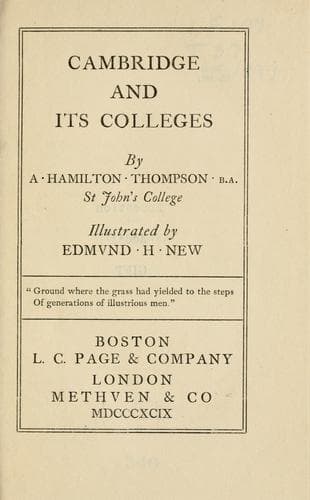
Cambridge and Its CollegesThompson, A. Hamilton (Alexander Hamilton)
History
Cambridge and Its Colleges
Thompson, A. Hamilton (Alexander Hamilton)
University of Cambridge
Ralph Symons, the great Cambridge builder whose name deserves to be more
widely known than it is, was the architect chosen to superintend the
works at Sidney. He was employed on Nevile’s Court at Trinity, and was, a
year or two later, to begin operations in the second court of St John’s.
Sidney, which was ready at the beginning of 1599, was quite comparable
with those famous works of art. As usual, the architect did not attempt
to manage a street-front. Here, however, instead of turning the back of
his buildings to the street, as at Emmanuel, he constructed an oblong
three-sided court, whose eastern side directly fronted the street. In
1628 Sir Francis Clerke of Houghton Conquest completed a second court on
similar lines. The south side of one court thus became the north side of
the other. This common side, which exactly bisects the building, was
terminated by a gateway opening on the street and into either court. In
this original plan the entrance to the Hall was immediately in the centre
of the eastern range of the north court; the entrance to the Chapel
occupied a similar position in the south court. We are still able to
admire this graceful and simple plan. But of the original buildings the
only remaining traces are the oriels in the garden-front of the Master’s
Lodge. In 1776 Essex, who had for the last ten years been “improving”
Cambridge out of knowledge, built a new chapel; and in 1830, while Dr
Chafy was master—the names of these masters deserve to be handed down—it
was decided to thoroughly remodel the college in the new Gothic style.
This step was prompted simply by the admiration which Wilkins’ doings at
Corpus, Trinity, and King’s had excited. Each college glowed with pious
emulation, and Sidney chose for its destroyer Sir Jeffrey Wyattville,
who had Gothicised a great part of Windsor Castle. Wyattville overhauled
the college in the Vandal manner; removed all traces, save those I have
referred to, of Symons’ obsolete work, and replaced it by the present
pretentious and insipid structure which adorns the eastern side of
Sidney Street. It is a comfort to know that a later generation has made
amends for this criminal error of taste. A court, or rather two sides
of a court, with cloisters, have been added in recent years by the late
Mr John Loughborough Pearson. This range of buildings, not very obvious
owing to the high walls behind which it stands, is of red brick, and,
like many other new buildings in Cambridge, is in the style of the
French Renaissance with English modifications. It is certainly one of Mr
Pearson’s great successes, and is, moreover, a success in a line which
he seldom attempted. The court—which contains, by the way, a very fine
Combination Room—is one of the most retired spots in Cambridge, and in
its studious shades it is possible to forget Wyattville’s ravages.
* * * * *
Public-domain text, read in full here on John Shaqi.
Reviews
Reviews
No reviews yet
Be the first to share your thoughts on this work.
Elsewhere in the archive
Join the Discussion
Join the discussion
Sign in to leave a comment or review.
Sign InorCreate an account