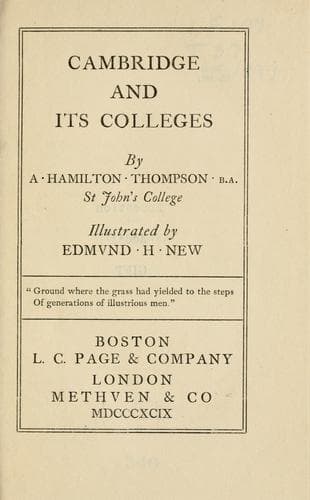
Cambridge and Its CollegesThompson, A. Hamilton (Alexander Hamilton)
History
Cambridge and Its Colleges
Thompson, A. Hamilton (Alexander Hamilton)
University of Cambridge
which was presented to the college, with a rather unnecessary parade of
anonymity, by Mr Holles of the Hyde in Essex.
The great name of Cromwell must not, however, suffer us to forget
the names of the good and pious men whom Sidney has nurtured. Dr
Edmund Calamy, the famous Nonconformist divine, was a member of the
college. So was Thomas Wilson, Bishop of Sodor and Man. So, too, were
Jones of Nayland, the revivalist and hymn-writer, and an even more
famous Evangelical preacher, Thomas Cecil. Sidney had, indeed, a very
conspicuous share in the revival of spiritual life at the end of the last
century. On the other hand, the college produced, by way of an anomaly,
Sir Roger l’Estrange, the Royalist pamphleteer, whose sympathies were
certainly apart from his education. The laborious antiquary, Thomas Rymer
of the _Fœdera_, was also a Sidney man. In our own century it has been
recorded that—
There was a young man of Sid. Sussex
Who stated that w + x
Was the same as xw!
So they said, “We will trouble you
To confine those ideas to Sid. Sussex.”
But any such misconception has been rectified by the present master, Mr
Charles Smith, whose mathematical text-books are classics in their own
branch of literature. And, among living members of the college, we may
notice the present Bishop of Bloemfontein, Dr John Wale Hicks, who is not
only celebrated for his equal skill in medicine and divinity, but, as
tutor of his college and vicar of Little St Mary’s, has had perhaps the
greatest spiritual influence on modern Cambridge life. Although Sidney is
a small college, there is none which is so remarkable for the patriotism
and good-fellowship existing among its undergraduates; and, within very
recent years, it has supplied the University with excellent athletes, and
one of its members has become president of the Union.
XIX
DOWNING COLLEGE
James Wilkins, the builder of Downing, must be distinguished from the
later William Wilkins, the gothic experimentalist. If the second Wilkins
had worked in the manner of the first, we should have missed some
valuable historical relics, but should have gained in other respects.
Downing, with its heavy angularities and immense porticoes, is not a
very great advance on the plans so cherished by Mr James Essex, but it
bears the marks of a good intention, and is an excellently proportioned
building. It was begun in 1807, but has never been finished, and now
simply consists of two parallel ranges running north and south, with a
wide space of lawn between them. Its situation is very remote, but to
this it owes its chief beauty, the lovely park with its fine avenues. The
view northwards from the park, embracing the fellows’ garden, and ending
in the towers of the new Roman Catholic Church, is worth seeing, although
the contrast of the classical college with one of the latest examples of
modern Gothic work is somewhat inharmonious.
* * * * *
Public-domain text, read in full here on John Shaqi.
Reviews
Reviews
No reviews yet
Be the first to share your thoughts on this work.
Elsewhere in the archive
Join the Discussion
Join the discussion
Sign in to leave a comment or review.
Sign InorCreate an account